Review: Hellboy 2: The Golden Army

Demon days

Rating: 4/5

Revert to Saved recently had Hellboy week, so you might already have an inkling that I’m a fan of Mike Mignola’s blue-collar demon. However, the first Hellboy film didn’t entirely deliver. Although it retained something of the spirit of the original comic, it lacked its humour and fascination with folklore, instead concentrating on Lovecraftian nutcases and an inevitably burdensome origins arc.

Hellboy 2 is an entirely different beast, and although the story has veered far away from the comics, the movie feels much more like Hellboy. It’s funny as hell (pun possibly intended), has buckets of visual flair and imagination, and ticks all the boxes on the emotions checklist, providing a balanced, engaging movie with plenty of heart.

The folklore angle also comes to the fore. The plot centres around elf prince Nuada (a surprisingly buff ex-Bros Luke Goss) declaring war on humanity and aiming to use the mythical Golden Army to reclaim the world for the legions of underworld creatures that mankind has forgotten. But, like with Mignola’s comics, there’s more to this than a bunch of brainless scraps between strange-looking beasties—this is intelligent craziness.

First, it’s hard to egg on Hellboy and company as they battle to contain the various foes Nuada unleashes on humanity—after all, the humans in Hellboy’s world are often greedy and soulless, and Nuada’s desperately trying to save his kind before they fade away forever. And while Hellboy is ultimately the ‘hero’ of the flick, his role becomes increasingly questionable: he fights for humans who’ll never accept him, killing his ‘own kind’, who perhaps need his help more.

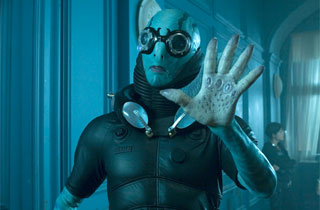
But it’s also telling that the most ‘human’ scenes in the movie happen with so-called monsters. Hellboy and fish-man Abe Sapien share one particularly memorable scene, drunkenly trying to understand the opposite sex. German mystic Johann Krauss—a disembodied ectoplasmic spirit—slowly realises that he’s lost his own humanity and needs to regain it. And even Nuada, despite his penchant for death and destruction, has sorrow etched across his face when his kind are harmed.

If there’s a negative aspect to The Golden Army, it’s that it sometimes feels like a series of set-pieces, strung together with a few slightly flimsy plot threads. However, the movie looks fantastic (not least the stunning clockwork Golden Army, and the troll market, which by comparison makes the Mos Eisley Cantina scene in Star Wars look humdrum), and it has more heart, humanity and imagination than any other movie I’ve seen this year, let alone other comic-book adaptations.

Abe Sapien

An angry Abe Sapien says how many stars he’d have given The Golden Army.

August 25, 2008. Read more in: Film, Rated: 4/5, Reviews

Comments Off on Review: Hellboy 2: The Golden Army

An interview with Mike Mignola, part five

Blood and iron

Hellboy 2 noticeably moves towards the mythology angle evident in the comics, instead of concentrating on the action and ‘Lovecraftian’ elements of the first.
That was a conscious decision that Del Toro and I both made, because the one element that was not in the first film at all was the folklore and mythology stuff. There was Lovecraft-meets-pulp-magazine-mad-scientist stuff. And so we decided for the second film to do the other side of Hellboy, the folklore and mythology. If you look at the two films together, you kind of see the range of Hellboy.

I was very happy to go in this direction, especially once we’d seen Pan’s Labyrinth, which I hadn’t seen when we made up the story. And maybe it would have been difficult, but when we went in and explained it to the studio—because we’re pitching a story where Hellboy fights fairies and elves, and no matter how much we tapdanced around, sooner or later someone would have to mention fairies or elves, and the other guy would have to jump in and say “It’s not what you think! It’s going to be really dark and really scary”—after Pan’s, it was a lot easier. We could say it’s kind of Hellboy meets Pan’s and everyone knew what we were talking about.

And when I actually saw Pan’s, we were going through a phase where the studio that was going to do the picture wasn’t going to do the picture, and it looked like it wasn’t going to happen. So suddenly all these things that I was reading in the screenplay where I was going “this is cool, but I’ve never seen them doing anything like this,” and “I wonder what it could look like”, once I’d seen Pan’s, I was like “Oh my God—now I see the flavour of Hellboy 2”. To see Pan’s and think we’re not gonna get a chance to make Hellboy 2, that was kind of a rough evening.

It’s kind of funny having to excuse your inclusion of elves and fairies. If you read the old myths, they’re dark and evil creatures.
Del Toro and I understood that, but people either think of cute fairies down the bottom of the garden or they’re thinking Lord of the Rings. With elves, people think of pointy ears, and when you talk about fairies, they only know cute ones. Well, they’ll see a nasty kind of fairy in Hellboy 2! It’s just not what what the film audience is used to, and it’s certainly not a guy sitting in a studio office is used to!

Hellboy also had an animation spin-off, with two DVD features. Where did the idea of that come from?
Well, Del Toro had talked about an animation a lot, but I think it was Revolution Studios that set up the whole animation thing. I wasn’t the driving force behind it—I’m never the driving force behind anything other than the comic. And so when I heard they wanted to do animation, I knew that there was a Hellboy fan named Tad Stone who’d been at Disney for years, but who was now available.

The first thing I said was: “Listen, if you guys are gonna do animation, hire Tad Stone, so someone up there understands the comic.” Because, clearly, Del Toro wasn’t gonna have the time to devote to the animated thing, and I didn’t have time and I’m not an animator. I knew what I’d do story-wise, but again it’s a different medium than the comic, so we needed somebody up there who knew animation, and knew the material and I that I could work with.

Fortunately for me—although I think the fans feel otherwise—they also said they didn’t want it in Mignola style… That was a studio decision, which I was fine with, because if it was in my style, I’d sit there going “Oh, they don’t understand it, they’re not doing it right!” Like when I see people imitating my work, I just see the mistakes. So when they wanted a different style, I thought this was great—one more thing to distance it from the comic and make it an alternate version of Hellboy. Just like Del Toro’s Hellboy is the live-action Hellboy, the animated Hellboy is the ‘Tad Stone’ Hellboy. Both of them are really faithful to the spirit, and the animation is probably closer to the stories that I did, but they’re both their own thing.

How do you personally correlate all the different versions of Hellboy, and which for you is the definitive version?
For me, it’s the one that came first—the one that I do—that’s the definitive version. There are things that I got to do in the animated films that were actually cooler than what I came up with, especially in the third film that it doesn’t look like we’ll get to do, but which was written. It was kind of a retelling of Hellboy’s origin, and a fun opportunity to revisit my material and do it differently.

But the way I did it in the comic is the real Hellboy. It’s my version, and my version has a beginning, a middle and an end that I hopefully will get to one of these days! What’s weird and takes a lot of getting used to now—and this is a good warning for people who are going to go into having work adapted—is that the real version, my version, is the version that the general public will be unaware of. I said to Del Toro the last time I saw him, when we were discussing our various ‘legacies’, that when I die—if anybody remembers and if Hellboy’s still a going concern—and someone says the creator of Hellboy died today, they’ll show a clip from the movie! They won’t show a panel from the comic, because that’s not what the public will know.

It’s funny how many people still don’t see comics as just another storytelling medium. In the UK and USA, you get people flocking to comic-book movies—many of which are actually dumbed down—but they won’t pick up a comic book!
Yeah, there’s still a prejudice against the subject matter, which is why it’s kind of funny they’re flocking to see something that they wouldn’t read, and that they think they know. Maybe with things like Spider-Man and Batman, they saw it as a kid—like the TV show or read the comics. But, you know, those things are in pop culture.

What’s a much bigger struggle is selling a movie like Hellboy, a character that the audience doesn’t know. How do you make it something that more than the 25,000 people that are buying the comic want to see? How do you get beyond that audience?

With thanks to Mike and Christine Mignola, and the guys at Dark Horse. The official Hellboy website can be found at hellboy.com. The Hellboy movie website is at hellboymovie.com.

Hellboy week navigation:
Intro | Part 1 | Part 2 | Part 3 | Part 4 | Part 5 | Part 6

Hellboy movie

August 16, 2008. Read more in: Film, Graphic novels, Interviews

Comments Off on An interview with Mike Mignola, part five

An interview with Mike Mignola, part four

Family story

The presentation of the Hellboy comic is quite cinematic. Was the potential for a movie always at the back of your mind?
It never occurred to me! I never even thought I was going to get to do a second Hellboy story. I thought that when I made up Hellboy, I’ll do this once… I tend to be fatalistic! I thought I’ll do this once, and then when nobody buys it, I’ll limp back to doing whatever job I can get from Marvel and DC Comics. What I wanted was something I’d be able to look back on and say at least once I got to put my personality on the page, before I went back to drawing fill-in issues of Iron Man or whatever it would be.

I was just so thrilled that I got to keep doing it as a comic, and I couldn’t get over the fact that I’d made up something that I still wanted to draw, because I’d never really drawn any one character for more than a couple of hundred pages. The fact that I enjoyed drawing this thing over and over again… I thought I’d won the lottery right there!

The whole film thing, even when it first came up, when Dark Horse first said they were interested in developing it as a film, I went: “Pfft! Sure! I’m very happy to take the movie-option money, as long as you guys want to keep optioning it. That’s great, because no-one will ever make a film of this!” It was beyond anything I imagined.

And then when I met Del Toro, I thought if anybody was going to make a film, he would be the guy to do it. But it was always such an uphill battle that I really never thought it was gonna happen. So, no, it was not something I ever anticipated.

When it was clear the movie was going to happen, what changes were required for the character to work on-screen, and how did you go about adapting it?
I’m not one of those guys who says it needs to be like the source material. In fact, one of the very first conversations I had with Del Toro, I said: “Listen, you turn it into whatever you want to turn it into. I’d love for you to keep true to the spirit of the character, but I actually have a different idea in mind for what I think would be a much easier sell for a movie”. Not that I was ever pitching it, but I thought of a way he could do it. And Del Toro said no, and that he wanted to make it like the comic. So, he was the one wanting to be faithful to the source material!

Yeah, he felt the love interest [between Hellboy and Liz Sherman] was necessary. I think as much as Del Toro loves Hellboy, he brought to it his own things he wanted to do. There were scenes in the first Hellboy film that he’s been trying to put on film for years, and he found Hellboy a great vehicle for some other stuff he wanted to do.

But that’s great. I didn’t want a filmmaker who’d just say, “Oh, this is what it is? OK, fine”. I wanted a filmmaker who went in there with his own agenda, because that’s where you’re going to get an interesting film. You want a filmmaker to make the film they want to make, not a film where they just take some money and put something up there.

So do you think this is a good way of creating a successful comic-book movie? Some, such as Sin City, are slavish, and some, like From Hell, barely resemble the original. But with Hellboy, it remains true to the original’s spirit, but with no effort to tie it into the comic’s continuity. It’s its own thing as well as still being Hellboy.
Right, and I think that basically there’s a lot of factors that have to fall into place, and the more I see of Hollywood, the more I’m amazed when something like that does work. I think in my case with Del Toro, we spoke so much the same language, even to the point that when he came over to my apartment right after we met for the first time, he noticed that we both put certain authors next to other authors on our bookcases, and that we’d read similar stuff.

We speak a very common language—film-wise, not quite as much, because he knows so much more about that—but I think we’re different guys with enough common ground to know we weren’t coming from completely different planets.

Despite the fact you said Del Toro should make the Hellboy movie his own thing, you were actively involved. Most creators either get the hump about translations, or take the money and run, but you wanted to be there. Why was that?
Del Toro wanted me involved, and he didn’t give me a choice! I want you there! I can certainly understand, having gone through it, a creator saying “Go make it, just give me the cheque,” because it’s really a difficult process.

I managed to work with Del Toro while we were hoping to make Hellboy—I’d done pre-production on Blade II, and that was fine, because it was someone else’s thing. Del Toro would say make up this, create this, and that’s fine. When we’re working on Hellboy, and we need to make up something different to what I had done… It’s one thing for me to say change it, and it’s another thing for me to be there changing my thing.

We saw eye-to-eye 95 per cent of the time, but the five per cent where we didn’t was really difficult, because it’s his film and so he’s got the final say on certain things with my character. So the only thing I could do to survive that process is really say the comic’s the comic, the film’s the film, and I’m here working with a guy I really like on his movie. I’m not working on my movie.

This is the one thing we had words about—when I’d say to him, “It’s your movie”, he’d say, “No, it’s our movie”. I’d say, “Well, OK, some days it’s our movie”, and there were a couple of days where it was his movie! For the most part though, it was a really smooth thing.

It’s the same for the second one—a very similar working experience. But more and more the film is Guillermo’s film, especially as the story veers further away from the comic. In a way, it’s actually easier for me the more it veers away from the comic, because it’s much easier to look at it as purely his film. I mean, when I was on the set of Hellboy 2, people would say to me, it must be amazing to see your characters walking around. That was funny, because I wasn’t even thinking of them as my characters—I was thinking of them as the Hellboy movie characters!

There are a couple of scenes where Hellboy is actually bare-chested, but wearing his coat, which is the way I’ve always drawn him in the comic, and he didn’t appear like that in the first film. When I saw Hellboy looking like the character in the comic, that was the only moment when I kind of went “Oh cool, there’s my character”. For the most part, I’ve gotten used to those characters as live-action characters being part of a Del Toro film.

With thanks to Mike and Christine Mignola, and the guys at Dark Horse. The official Hellboy website can be found at hellboy.com. The Hellboy movie website is at hellboymovie.com.

Hellboy week navigation:
Intro | Part 1 | Part 2 | Part 3 | Part 4 | Part 5 | Part 6
Hellboy movie

August 15, 2008. Read more in: Film, Graphic novels, Interviews

Comments Off on An interview with Mike Mignola, part four

Hellboy week on Revert to Saved

A six-part interview with Mike Mignola this way comes

A few months ago, I was lucky enough to speak with Mike Mignola about his work in comics and the film industry. He provided insight into his illustrative style, the inspiration for his Hellboy work, and what it’s like to see your creation move to the big screen. Since the bulk of the interview never saw the light of day, due to the restrictions imposed by limited space in magazines, I thought I’d run the interview over the next week or so, to whet people’s appetites for the British release of Hellboy II: The Golden Army.

So check back over the coming days for one of the most comprehensive interviews with comics legend Mignola that you’re ever likely to read.

Update: all six parts are now online—Intro | Part 1 | Part 2 | Part 3 | Part 4 | Part 5 | Part 6.

Mike Mignola

August 12, 2008. Read more in: Film, Graphic novels, Interviews

Comments Off on Hellboy week on Revert to Saved

Review: The Dark Knight (Batman)

Dinner, dinner, dinner, dinner, dinner, dinner, dinner, dinner

Rating: 3/5

I like to go into films blind. That way, I’m more likely to have an experience that will surprise and enthral. With The Dark Knight, this wasn’t possible. Not only was the Joker’s presence all but guaranteed during the ending to Batman Begins, but Heath Ledger’s death has elevated his performance in many people’s minds to the status of some kind of acting god. The net result is that the hype machine has been on overdrive, with pretty much everyone calling this the Best Comic Film Ever.

I disagree. That’s not to say it isn’t good, nor that it’s not worth watching. However, I sat there only mildly entertained by the plot and slightly disturbed by the brutality (in excess of most comic-book movies, and certainly over-the-top for a 12A film, but you’ll have seen a lot worse elsewhere). What lifts the film above merely average is some impressive stunt-work, one or two decent twists, and Ledger’s engaging Joker, who seems to be channelling a little Jack Nicholson and quite a lot of Michael Keaton throughout.

What almost drags the film down again is, well, almost everything else. Like Batman Begins, this movie is somehow hollow and lacks soul. And seemingly content to cherry-pick the best bits from various Batman comics (Alan Moore’s The Killing Joke, Frank Miller’s The Dark Knight Returns, etc.), thereby offering an almost Batman-by-committee result, the film lacks focus. Perhaps it tries to tie too many threads together, but the result is convoluted and feels rushed, despite its extended viewing time.

The onus is largely on the escalation of warfare between Gotham’s most famous vigilante and the enemies around him—in other words, if it wasn’t for Batman, these super-villains wouldn’t exist. This has been an ongoing theme in Batman for some years now, although I’m pretty sure we didn’t need the Joker rather clumsily spelling this point out to Batman at one point during the movie.

And so although we get a standout (if not Oscar-worthy) performance from Ledger, some crunching battles, a few great scenes (notably a fast-paced bank heist that’s at once wicked and funny, but also almost anything Two Face does during his limited screen time) and a film that hammers home the ‘dark’ in ‘Dark Knight’ (repeatedly), we also have a somewhat self-important and gloomy production that’s at least a half-hour too long.

The Joker

Once again, the Joker lost during the first round of Celebrity Poker Showdown.

July 28, 2008. Read more in: Film, Rated: 3/5, Reviews

2 Comments

« older postsnewer posts »