Review: International Karate Plus (IK+)

Hiiiiyaaaaaaaaaaa!

Rating: 4/5

Once upon a time, all fighting games were about Eastern pyjama-wearing gents kicking each-other in the face. They were sedate affairs, based on tactics and cunning, epitomised by Melbourne House’s Way of the Exploding Fist. And then IK+ arrived, blowing everything else out of the water.

On the surface little had changed: there was an extra fighter and a prettier backdrop. But having that extra competitor on-screen transformed the fighting genre, turning the sedate into the frenetic, ensuring the player rarely got a chance to catch their breath.

In today’s market, IK+ looks blocky and dated. The C64’s graphics lack the charm of a Pac-Man or a Mario and the definition of a Spectrum title. But the animation is fluid, and the collision detection spot-on.

Importantly, though, the gameplay still shines through after over two decades. Moves are carefully assigned to logical control positions, making fights intuitive and instinctive, rather than a memory test. And with its combination of varied opponent styles (they change every level), frantic bonus game (deflect bouncing balls with a shield) and its lack of button-mashing, this classic from yesteryear genuinely manages to give most of its modern equivalents a thoroughly good kicking.

IK+ is available now on Virtual Console for 500 Wii points (£3.50ish). If you think that’s too much for a 21-year-old game, more fool you.

IK+

Old man speak wisely. Red player can’t even tie belt properly.

September 12, 2008. Read more in: Commodore 64, Gaming, Rated: 4/5, Retro gaming, Reviews, Wii Virtual Console

Comments Off on Review: International Karate Plus (IK+)
Review: New International Track & Field

Causing lactic acid build-up since 1983

Rating: 4/5

Konami understands retro gamers. Unlike certain other companies, Konami isn’t content shovelling the same old garbage out to consumers time and time again. Instead—and particularly with handheld games—its retro content appears full of thought and devotion.

This was definitely the case with Arcade Classics for the GBA and last year’s similarly titled DS compilation, but New International Track & Field shows that the same magic still flows through Konami’s veins when it comes to more focussed titles.

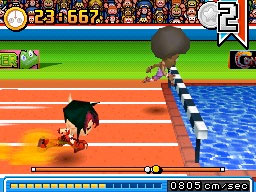
As its name might suggest, New International Track & Field is the latest in Konami’s long-running sports series. In practice, it’s essentially 1983’s Track & Field and 1984’s Hyper Sports mashed together, doubled in size, and redecorated, with the ’80s pixelated athletes replaced by a cast of super-deformed Anime-inspired characters.

Gameplay, however, remains firmly retro, with the button-bashing of the original titles replicated by smacking seven shades out of your DS buttons. And for users who grew up with joystick-waggling home conversions, the alternate control method of frantically scrubbing the stylus back and forth evokes fond memories of severe arm-cramping to shave a tenth of a second off of your best 100 metre dash time.

Although some of the events are needlessly fiddly (mostly regarding timing—something not helped by the intermittently inept instructions provided), most are actually a lot of fun. Double-trap shooting is perhaps the best, practically identical to the skeet-shooting event in Hyper Sports and similarly addictive. Springboard, javelin and archery also provide a decent mix of physical endurance and precision timing that ensures this compilation isn’t all about repetitive scrubbing or bashing.

As is seemingly law these days, New International Track & Field begins with most of its content locked, and while most unlockables are trite (such as new character outfits), some achievements unlock new characters that have their own challenges. These are typically based on events elsewhere in the game. Standouts include Evil Rose’s hammer variation, where competitors are thrown from a wrestling ring on to a scoreboard, and Simon Belmont’s skeet-shooting-inspired-vampire-bat-massacre, set in a spooky castle.

A few irksome difficulty spikes, a couple of really awkward events, and the hateful way in which you can enhance your athlete’s performance by yelling into the microphone (quick tip, DS developers: using the mic like this makes gamers hate you) stop New International Track & Field from reaching the dizzy heights enjoyed by retro remake Space Invaders Extreme, but Konami’s game isn’t too far off the pace and wins a well-deserved silver medal.

New International Track & Field is out now, and although it’s not worth the 30 quid RRP, it’s well worth tracking down for a wee bit less.

New International Track & Field

Repetitive? Sure. Painful? Definitely. Fun? Too right. God knows why, though.

September 7, 2008. Read more in: Gaming, Nintendo DS, Rated: 4/5, Retro gaming, Reviews

Comments Off on Review: New International Track & Field

Review: Arkanoid DS

It pongs. You won’t want to break it out at a party. Etc.

Rating: 1/5

“It may seem familiar, but it’s like nothing you’ve ever seen before!” boasts Taito about Arkanoid DS. However, this isn’t entirely true—I’ve seen plenty of half-baked Breakout games over the years.

The fact remains that Arkanoid was never that good in the first place. Stripped of its shiny graphics, it was just another in a long line of bat-and-ball games, albeit one with a few power-ups and some nice level design. Converted to home systems, it was soon bettered by a slew of contemporaries, including Krakout and Traz, with only the most devout of Arkanoid followers continuing to fly its flag.

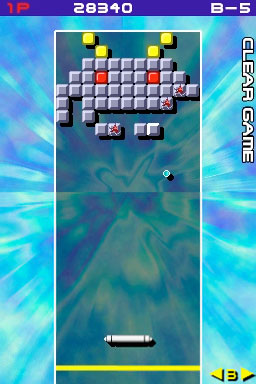
Arkanoid DS, however, manages to stamp on even on the rose-tinted glasses of those deluded souls. Vapid layouts combine with graphics that would embarrass a Commodore 64 to make a game that appears more dated than the mid-1980s arcade original. And if you’re waiting for me to say “but at least the gameplay remains intact”, you’re going to be disappointed: of all the Breakout-oriented games I’ve played, this is one of the worst. It’s too easy, far too dull, and you tend to get stuck for ages on the ‘last brick’, something hardly helped by the play area stretching across both DS screens and yet also being extremely narrow.

If Arkanoid DS was a homebrew effort, I wouldn’t be so scornful, but this is a commercial product. And when you compare it against Space Invaders Extreme, you see just how far Arkanoid DS is from being an exciting and essential update.

Arkanoid DS is out now, if you’re interested (read: if you’re a masochist). The Japanese version also comes with a little detachable DS paddle, but the game’s still rubbish.

Arkanoid DS

This is one of the best levels in Arkanoid DS. Seriously.

August 22, 2008. Read more in: Gaming, Nintendo DS, Rated: 1/5, Retro gaming, Reviews

Comments Off on Review: Arkanoid DS

Eugene Jarvis on the reality of clones in the games industry

Recently, I was lucky enough to spend a couple of hours talking to games designer Eugene Jarvis, the chap responsible for, amongst other titles, Robotron: 2084 and Defender. The guy is one of those genius types who’s about as modest as they come. Handily—what with me interviewing him for various magazine articles—he also happens to be witty and able to provide plenty of insight into gaming’s past, present and future.

One of the things gaming’s typically accused of in the modern era is churning out more of the same, crushing innovation underfoot. Jarvis has a different take:

I’m blown away with how games have gone. Look at Defender side-by-side with Halo or BioShock, and all these modern games, and see where we got in 25 years… It’s amazing how from year-to-year we’re always complaining that everything’s just the same as the last game—sequel upon sequel. But we used to say that in the Space Invaders era! It seems like from year-to-year, we’re always decrying the lack of progress. But then after 25 years of that, it’s like: holy cow! [laughs] 25 years of cloned games and we’ve gone a long way!

I’m usually the first to complain about stagnation within gaming and a lack of innovation, but Jarvis offers a good point. Sometimes, it pays to take a step back and make a more direct comparison between past and present. Evolution isn’t always fast, and like watching a child or plant grow, it often takes juxtaposing things ten years apart to see how much something has changed.

That’s not to say that there aren’t massive problems in the current games industry, because there are. However, this most-talked-about of concerns has clearly been a headache since the very start of gaming (indeed, Jarvis noted that Robotron: 2084 is basically Space Invaders crossed with Berzerk!, and that Defender evolved from a batch of Space Invaders and Asteroids clones), and so perhaps it’s time to get over the cloning issue and just enjoy gaming’s continual—if decidedly inconsistent—evolution on the path to who-knows-where.

Robotron

Robotron: 2084. If you’re a youngster, this is where your modern console game’s controls first appeared.

July 30, 2008. Read more in: Arcade, Gaming, Opinions, Retro gaming

1 Comment

Review: Civilization Revolution DS

He’s got a whole world in his hands

Rating: 3/5

As someone who’s been pining for a DS version of Civilization for a couple of years, I wonder whether the realisation of such a product could ever have been anything other than a disappointment. Unfortunately, after a few weeks’ play, ‘disappointment’ pretty much sums up my opinion regarding the DS port of the latest game in the famous turn-based strategy series.

To be fair to Firaxis and Sid Meier, it’s actually the DS itself that causes some of the problems with this game, and the Civilization core remains largely intact. You get to take a civilization from prehistory to modern times, building and moving units, researching technology, and aiming to become the greatest in the world via various means (domination, economics, technology, or by building the UN). However, with Civ basically being a strategy title, it’s problematic when that aspect of the game is hampered.

First and foremost, the DS screen is too small to provide you with a decent overview of the world. Although the team wisely ditched the 3D graphics from the PS3 and Xbox 360 versions, opting instead for an iconic approach similar to the original Civilization, the map still feels cramped, and moving around it is a chore. This problem could have been alleviated somewhat by providing the option to allow the map to appear—at least optionally—on both screens; unfortunately, one screen is mostly reserved for pointless battle animations.

Elsewhere, the streamlining of the original concept to hammer it into consoles rather than PCs and Macs has neutered it. Although the game is faster, it’s become more of an overt race than a game of chess. Instead of investing in technology and thinking of long-term plans, a war-obsessed AI largely forces games into tending towards moving units, protracted wars and conquest. The technology tree is very basic, and random events are frequent and absurdly powerful. It’s not uncommon to end up with tanks in 200 AD, especially if you stumble across Atlantis, which always spews forth a number of technological advances.

It’s not all bad news—the game is quite fun, and gives you a quick Civ-style fix for when you’re away from your PC. However, rather than being captivating in a ‘total addiction’ sense, this game instead feels ‘annoyingly’ compelling in the same way as Puzzle Quest: you can’t put the game down, but in your heart of hearts you know it’s actually a somewhat tedious slog that could have been a lot better.

Civilization Revolution is already out in the US, and comes to Europe towards the end of August.

Civ on DS - sorta

Sadly, Civilization Revolution doesn’t have a whale unit—it’s just a resource icon.

July 29, 2008. Read more in: Gaming, Nintendo DS, Rated: 3/5, Retro gaming, Reviews

6 Comments

« older postsnewer posts »