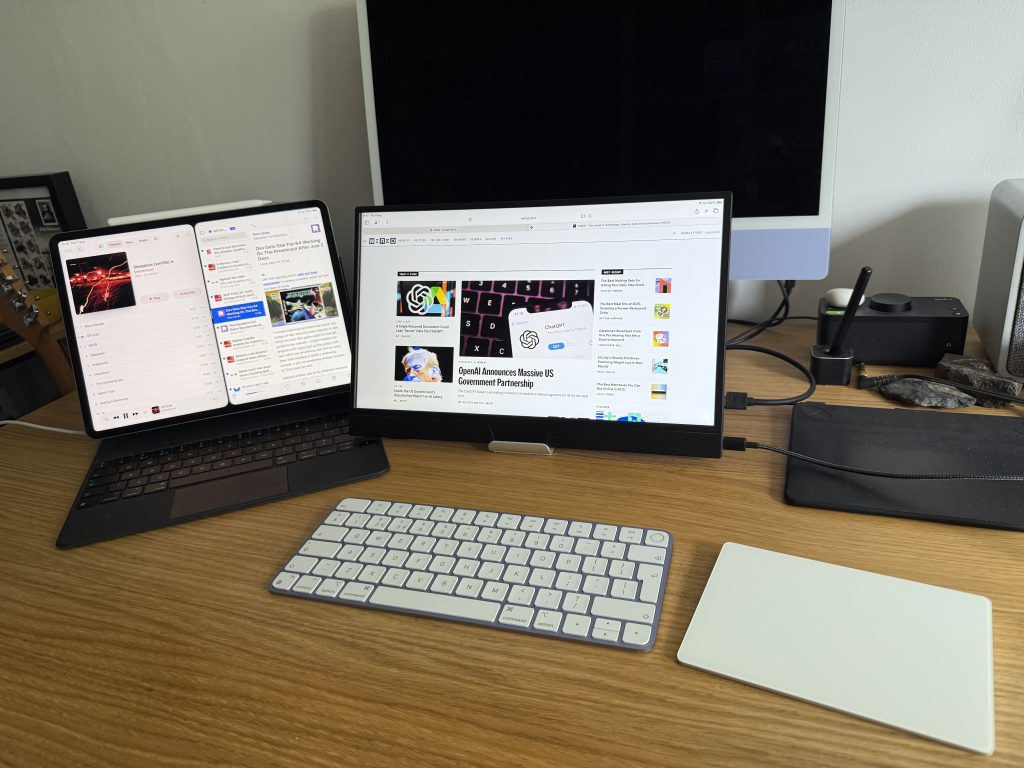
Apple finally destroyed Steve Jobs’s vision of the iPad. Good. That’s my thinking in my latest for WIRED, which explores how Cupertino has done the thing it swore it never would: turn its tablet into a full-blown window-wrangling, compromise-abandoning computer. Yes, it’s better, but lurking deep in the settings the ghost of Jobs remains.
I replaced my Mac with an iPad for an entire week. It went as well as you’d expect.This piece, also for WIRED, went all-in. I shut down my iMac and used an iPad running iPadOS 26 for a week to see if it could pass muster. And the article title? It’s probably a Rorschach test, because what happened during the week included plenty of surprises – not all of them bad.
What would you do if Google, Apple and Microsoft closed your cloud accounts without warning?My column for Stuff this week expands on my mulling over the point a couple of weeks back. In short, the cloud is great – until it isn’t. If big tech slams the door in your face, you can lose everything.
What’s wrong with Apple? The company is insanely rich. Its hardware is phenomenally popular. And yet a prevailing narrative argues things are all going wrong. Again for TapSmart, I explore why.
I went to Iceland. First long trip in some time. Visited family. Saw some sights. Lots of time to just sit and watch the world go by, which I really needed. Naturally, I also shot dozens of photos. I’ll be sharing some of my favourites on Bluesky and Mastodon over the coming weeks. Iceland is such a beautiful country.
Stop-motion animation on a phone? In these days of AI prompts, putting in the effort to make animation might seem quaint – even foolhardy. But I’ve long thought it feels like magic that you can do this on a phone. I round up my favourite apps here.
Your favourite companion! No, not the plastic and metal one. The furry one. Turns out the former can work for the latter though. Check out my pets toolkit for how.
A playground fight within a single machine.That’s how I described the third issue of the ZX Next, which adds a C64 core. Now, the project is going a step further, chucking a CPC into the box as well – if the Kickstarter campaign hits £2.5 million. One week to go!
Could Apple convince me to spend $2000 on an iPhone Fold? Probably not. But my Stuff column this week says what Apple would need to do to tempt me.
Age verification in the UK is a disaster. I predicted this in my column last weekend. But I’m nonetheless surprised by how badly it’s gone. Reddit is blocking subreddits on sexual assault and periods. Spotify is blocking access to a range of content unless you verify your age. Wikipedia is challenging the UK government in court.
Predictably, the press and political response has been dreadful. The former are conflating porn sites and sites that “may contain pornographic content”. And Labour’s Peter Kyle suggested, in facile fashion, that every time an adult verifies their age, they are protecting a child. Meanwhile, teens are merrily installing VPNs and using Norman Reedus’s face to get around age checks.
A few months from now, everyone will act all shocked when teens are still accessing porn, British adults are blocked from an increasing amount of content, a massive data leak occurs with verification data that was supposed to be anonymous, and the entire UK is blocked from Wikipedia. Labour ministers will then be wheeled out to say on TV that’s a “small price to pay for protecting children”.
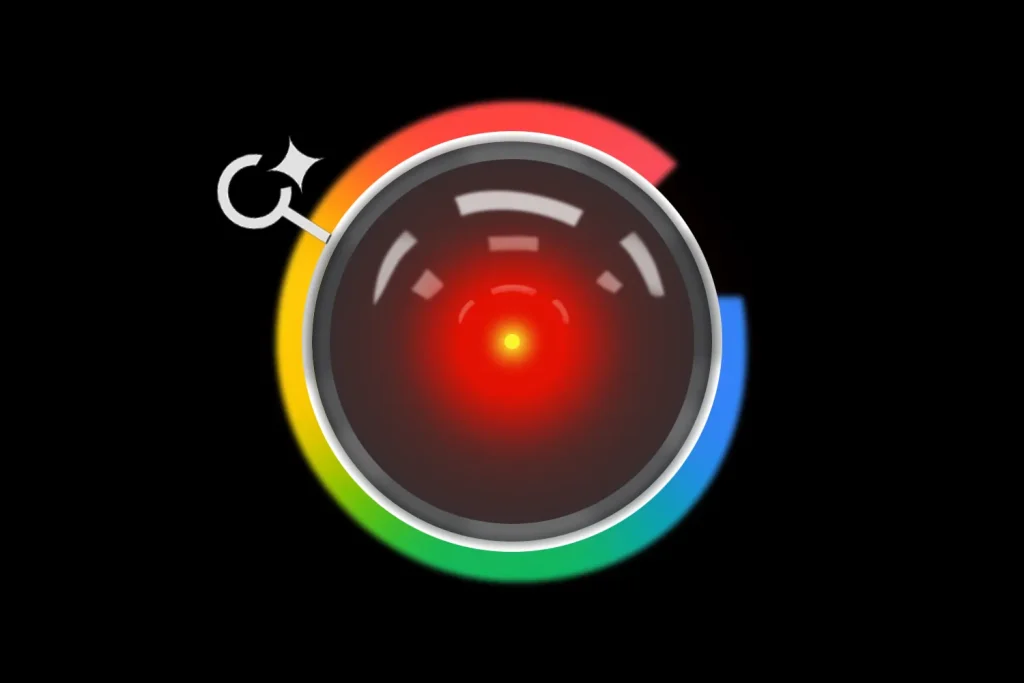
What if your cloud accounts were blocked, without warning? I asked this question on Bluesky and Mastodon after yet another report of a user’s Google account being abruptly shuttered for no obvious reason. The threads are well worth perusing for people’s thoughts and recommendations. I suspect even most folks with a robust backup system aren’t really thinking about what they’d do if Google, Apple, Microsoft or Dropbox banned them.
Liquid Glass still sucks.I posted this shot of an unreadable iPad menu bar. Someone suggested app devs should update their UIs to make them work with Apple’s design, despite it being a moving target. I’d argue Apple should stop mucking around and just stick a solid colour behind the new menu bar.
I switched to DuckDuckGo on my iPhone and wrote about it for TapSmart. It’s been an interesting experiment. Notably, I haven’t switched back to Google yet.
Bring back Music Memos! OK, so that’s never going to happen, but my article outlines why I’d love to see its feature set integrated into other Apple apps.
There’s a new WALL-E and EVE Lego set. Lego is going to sell so many of these.
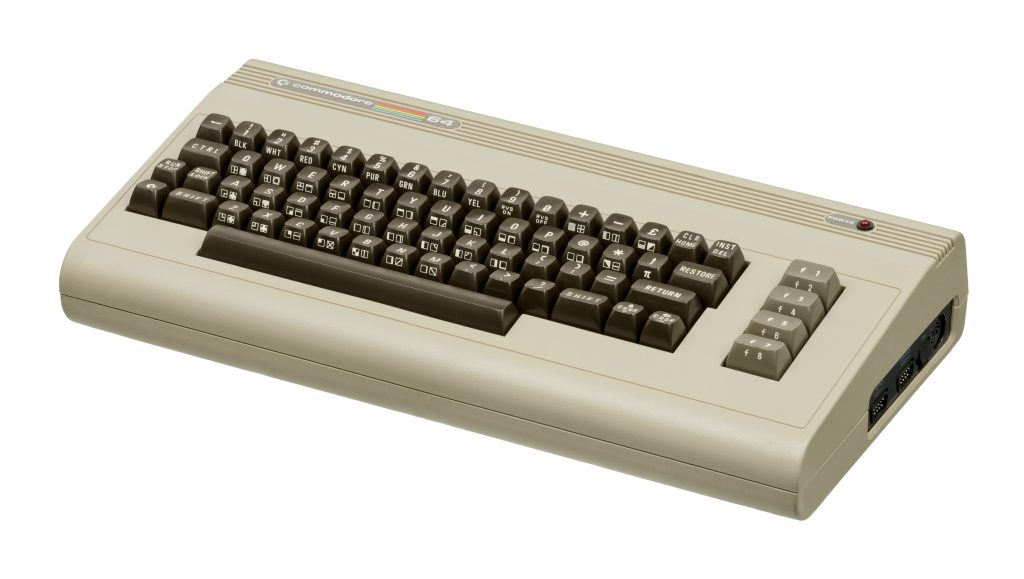
Commodore is back. Sort of. I wrote for Wired about the latest comeback from the once iconic brand, and the hurdles the new owner faces that could impede success. It’s also been interesting to compare Ultimate C64 presales and marketing to the ZX Spectrum Next. And to see ‘another Commodore’ appears ready to fight for rights to the brand.
Age verification arrived in the UK. I wrote about this for Stuff: I just proved I’m an adult online – and I’m torn about what that really means. I’m not against age verification in principle. But I question whether it will be effective and am against current implementations, which place onerous burdens on small companies and somehow manage to combine spotty coverage and massive overreach.
Think of the children has also extended to Itch.io delisting all NSFW games, as expertly covered by John Walker for Kotaku. Elsewhere, Labour is mulling legislation for screen time limits and curfews (Sky News). I’m so sick of this meddling from government. Screen time systems already exist. Parents just need to start using them. It whiffs of the same brain rot that’s behind school smartphone bans.
Speaking of Labour, it’s still anti-PR. In a disingenuous response shared on Bluesky, a Labour minister inferred we need FPTP for direct constituency links (some proportional representation systems retain this), and said the Liberal Democrats lost a referendum on scrapping FPTP. The latter is true. But what the minister didn’t mention is how neither Labour nor the Conservatives would budge on AV as the alternative to FPTP. The Libs then unwisely accepted AV as a grubby compromise. (AV is not PR – it’s a majoritarian system.) And then the Tories, the press and the Labour Party fought against change. What’s wild is Labour hasn’t shifted its position. Sure, in 2024 it won a huge majority on a low vote share. But that means others – Reform UK Party Ltd or the Tories – could pull the same trick next time, despite the UK more often than not placing the majority of its votes with relatively progressive parties.
Fancy a 996 work week?Kate Knibbs writes for Wired about rich white folks in the US advocating people work 9am–9pm six days a week, because Steve Jobs and Bill Gates worked insane hours. Said rich white folks appear to forget that Steve Jobs and Bill Gates owned massive chunks of their respective companies and got extremely rich from their efforts. The average worker will not. Still, I suppose at least these people aren’t advocating a 996-hour work week. Although they probably would if science would permit.
It was a big week in retro-gaming. I wrote about the Amiga and Atari ST turning 40, not at all making fans angry with my best-games selections. Atari painted a 2600+ yellow for a Pac-Man edition. And Lego made a Game Boy.
Forever Notes is fantastic. I’ve been exploring this system for a while, making sense of my notes within Apple’s Notes app. I don’t use the full scope of Forever Notes, but outlined in this article how even the basics can be transformative.
Apple UI design is still terrible. I think I’m done with people making excuses for Liquid Glass. “It’s just a beta” does not excuse basic day-one design errors that would in my day have had my boss yelling at me to go away and do it properly. White text on white backgrounds. Black text on black backgrounds. Other UI that’s indecipherable. Tabs that look like there’s murk stuck behind them, or that flash light and dark as you scroll – to the degree I’m genuinely wondering if Apple’s flirting with photosensitive epilepsy accessibility problems.
Elsewhere, Apple is still obsessed with hiding UI; I agree with Eric Schwarz, who said: “I don’t want my browser to have less controls or usable navigation just so that we can see 1/8in more of a web page”. And I was happy to Jason Snell write that he keeps “noticing how terrible toolbars look in macOS Tahoe”. I’ve hated these since the first beta. The drop shadows make toolbar buttons the most visually prominent thing in the field of view. As with live refractions on tvOS controls, stuff like this makes a mockery of Apple’s argument these redesigns are about letting you focus on content. They distract from content. They make it harder to interact with content. Awful.
AI piracy slop hit a paywall. And then, as Clara Murray on Bluesky showed, it stopped ripping off an FT article and flipped to summarising the paywall text. Amazing.
A big Carlos Ezquerra book is on the way. And I mean really big. He’s getting an Apex Edition that will include some of his greatest Dredd and Strontium Dog art. I own a few of these Apex Editions and they are gorgeous books. I don’t want to miss this one. But I’ve no idea where I’m going to store them all if too many more rock up.
My town’s schools just banned smartphones. I think that’s a bad idea. Which, as I’ve discovered this week, isn’t a popular take. But there’s too much blaming of tech itself rather than how it’s supplied, managed and used, and less attention paid to the benefits it can bring. The column looks at the practical ramifications of a ban, from personal security to e-waste. (Katie Spalding a while back expertly called parent pledges to ban phones themselves “abstinence only phone education”. Brilliant.)
The next ZX Spectrum will also be a Commodore 64. Seriously. Well, sort of. The third and final run of the ZX Spectrum Next, a super-Speccy that uses FPGA to ‘be’ any Sinclair machine, will now be able to become Commodore’s finest too. Which is deeply funny, because that’s basically a 1980s British playground argument in a box.
Another Sinclair wants to spark a gaming revolution. Sir Clive’s nephew launched featherweight handheld GamerCard. It’s a bizarre thing – ultra-skinny with weird controls. It’s hard to imagine how it’ll be when actually playing games – even Pico-8, for which its display is ideal. Still, it’s tempting, despite being painfully spendy.
Sony’s first portable console turned 25. No, not that one. I’m talking about the PS One, which I wrote about along with a handful of other interesting Sony console side-quest updates.
UK websites want to verify your age. The Verge reported Bluesky and Reddit are early out of the blocks. Brits on Bluesky lost their minds, apparently unaware that this isn’t about one or two sites – it’s all of them. And the system doesn’t scale, demanding account creation and age verification with each individual site, entrusting numerous third parties with your personal data. At some point, this will end in a massive data breach. I also imagine we’ll see many sites simply block UK traffic rather than deal with the hassle. And, no, “just use a VPN” is not the answer to tech overreach.