This morning, The Pirate Bay Four (a name that the media isn’t using to make the four people involved in The Pirate Bay sound evil, honest) were found GUILTY of being evil, nasty pirates, and sentenced to a year in prison each, slightly short of the ‘death by having eyes gnawed out by rabid squirrels’ punishment major Hollywood studios, record labels and videogame companies were aiming for.
But, in the nature of this site’s ‘helpful hints‘ series, here are some facts (or FAQs, if you’re so far gone into Web 2.0 that your skin tone is now a gradient) for any news organisations too stupid to understand what’s been going on:
- These people aren’t actually pirates. Pirates are genuinely nasty people who go around in boats and attack other boats for hostages or huge piles of ‘stuff’ they can offload for ‘cash’. Nor are these people facilitating piracy. Piracy is the act done by the aforementioned people who go around in boats, attacking other boats. It could be argued that The Pirate Bay was, by the nature of the technology used, facilitating bootlegging, but that doesn’t sound nearly as exciting.
- The Pirate Bay isn’t the only site where you can download copyrighted material. This will come as a huge shock to many news outlets, but at the last count there were—to use a technical term—a f*ck-load of similar sites around. I should know—my latest book appeared as a ratty, badly scanned PDF on most of them approximately three seconds after being put on sale.
- BitTorrent isn’t a technology for “illegally sharing movies” from “poor widdle Hollywood companies that are going to cry real tears of pain” if you don’t buy their DVDs with over-inflated prices (six months after the USA gets that chance, if you live in Europe). In fact, it’s just a file-sharing technology (working in peer-to-peer fashion, thereby avoiding single-point-of-failure and reducing bandwidth resources for any one ‘sharer’). Idiots in the media might want to read the main bit of that bit again. BirTorrent is just a file-sharing technology. The Pirate Bay, despite its knowing name, therefore actually allows you to download a whole range of material, and in a manner that doesn’t make a single provider scream for mercy.
- This could have been welded to the previous point, but it deserved its very own number: Far be it for me to point out the very simple fact that many of the companies crying their widdle eyes out are the same ones releasing a shed-load of material via BitTorrent, to get it spread more quickly and save on bandwidth costs, thereby being ably assisted by torrent trackers. You know, torrent trackers like The Pirate Bay.
April 17, 2009. Read more in: Helpful hints, News, Opinions, Technology
Given how much care Apple usually puts into its products, and especially into the small details, it’s amazing that the App Store’s ability to count is worse than Sesame Street’s resident vampire after a full-frontal lobotomy.
The iPhone’s App Store app is terrible at doing this, regularly flagging a certain number of updates and getting the total wrong. But iTunes is even worse. The Applications sidebar item will cheerily tell you about new app updates, you’ll click it, and you’ll then be told no updates are available. Cleverly, the Applications icon won’t then update, sticking to its guns that there are updates to be had, despite the fact there clearly aren’t.
This morning, the farce was in full swing. “One app update,” exclaimed the Applications item. I click it. There are six items ready for download. Duly downloaded, the App Store happily tells me there are no more updates. Inexplicably, the Applications item now claims there are two apps ready for download.
This probably sounds needlessly picky (and, to some extent, it is), given that no other company has come close to emulating the App Store (and, frankly, I think few will, even in the long term). But it’s hard to always sing the App Store’s praises when the damn thing can’t even count.
UPDATE: Purely by chance, I today discovered that this ‘quirk’ is down to there being multiple accounts on my Mac. Although one account was up to date, another had apps ready for download. Of course, iTunes doesn’t actually bother telling you this might be the case, and so it’s still a black mark for Apple, for an unusually unintuitive UI decision.

So, do I have two downloads ready or none at all, App Store? TELL ME!
April 10, 2009. Read more in: Apple, Opinions, Technology
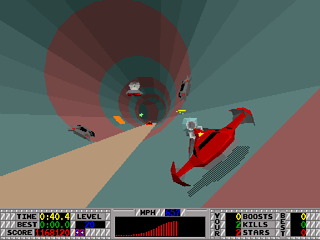
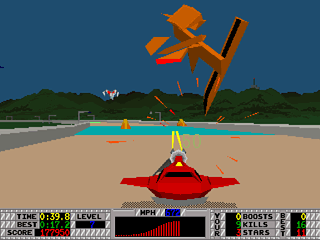
Some gaming experiences stay with you forever. I’ve played more videogames than I care to remember, on many different platforms, but I distinctly remember ambling into a very small arcade in Clearwater and, among the beaten-up and half-dead machines, spotting S.T.U.N. Runner.
Akin to smashing a futuristic bobsled game into a rollercoaster experience with a hammer, S.T.U.N. Runner got over the feeling of speed in a way no games had done before and few have done since. The pace was breathtaking to my younger self, and the game over incredibly quickly. But on getting to grips with the game’s mechanics, S.T.U.N. Runner became a fantastic means to while away an hour, escaping from the hot Florida midday sun.
Snapping back to more recent times, Ed Rotberg was kind enough to chat with me last year about his classic tank game Battlezone, and we then talked about S.T.U.N. Runner. Preparing for the interview a day earlier, I fired up the game in MAME and had forgotten how pretty it is. Sleek vector-based designs shoot past at breakneck speed, and even when using a PC, control of the craft is just perfect.
Perhaps this is nostalgia putting the boot in, but I think it’s a massive shame that the game has never been done justice on home formats (with the exception of an astonishing and surprisingly faithful Atari Lynx effort), because even in today’s rush for increasingly extreme gaming experiences, S.T.U.N. Runner still impresses.
My interview with Ed (and co-conspirator Andrew Burgess) is in the current Retro Gamer.
April 8, 2009. Read more in: Arcade, Gaming, Magazines, Retro Gamer, Retro gaming
The standard online retailer guide to updating an online store:
- Upload products quietly, in the background, without fuss. Maybe if the product is particularly exciting, add it to the front page.
The Apple method of updating its online store:
- Accidentally leak a minor product shot by accidentally uploading it a few weeks before release. Accidentally. Really.
- Wait for hundreds of Apple rumour websites to get terribly excited about a tiny incremental update to a nothing product.
- Watch as frenzied Apple fans argue about what other updates are on the way, such as a $5 solar-powered iPhone that also makes perfect toast and tea via WiFi.
- Abruptly take down your entire international online store, making it impossible for anyone to buy anything. Add an obnoxious post-it note for good measure.
- Wait as Apple fans drive themselves into an apoplectic frenzy, trying to figure out what exciting new things are going to be added imminently.
- Watch as Apple news sites report that you took your store down, which means exciting things.
- Sit back and laugh heartily, safe in the knowledge that even though the updates are tiny, you’ve just got more marketing than most companies get for a new product launch.
- Put the site back online, with as many ‘new’ badges as possible.
- Wait for the internet to recover from millions of Apple users refreshing the Apple store fifteen times per second.
- Wait for orders to flood in from Apple users starved of the store for a full 90 minutes.
- Lather, rinse, repeat.
April 7, 2009. Read more in: Apple, Humour, Technology
Imagine’s answer to EuroGamer, NowGamer, went live recently. With the publisher having a dedicated retro magazine—the rather spiffy Retro Gamer—it should come as no surprise that NowGamer offers a dedicated retro section.
Most of the section appears to be reprint, but there’s some great stuff in there, including a slew of making-of articles, a smattering of company profiles and a couple of ‘def guides’ to videogame series. A fairly random selection of my own articles has been reprinted on the site, including The Making Of: Hitchiker’s Guide To The Galaxy, where I interviewed Steve Meretzky about his collaboration with Douglas Adams.
The game itself remains one of the meanest, toughest and funniest pieces of interactive fiction to date, and with the original article buried away in an old issue of Retro Gamer (and not making the cover nor even the contents pages), it’s great to see it get another airing, not least because Steve Meretzky was a wonderful interviewee. I hope that we can one day talk about the controversial Leather Goddesses of Phobos, which would make for a fun making-of in the mag.
Elsewhere, you can also read my making-ofs on seminal soccer title Sensible Soccer, ubiquitous action puzzler Tetris, US platformer Miner 2049er, fantasy/chess mash-up Archon, and overhead bouncing ball action game Bounder.
As for the magazine itself, Retro Gamer’s on the stands, priced £4.99, and can be bought from retrogamer.net. The current issue includes a making-of Space Invaders, Amiga and Mega Drive retrospectives, and my interview with Ed Rotberg and Andrew Burgess on their classic S.T.U.N. Runner.
April 6, 2009. Read more in: Gaming, Magazines, Retro Gamer, Retro gaming