Review: Arkanoid DS

It pongs. You won’t want to break it out at a party. Etc.

Rating: 1/5

“It may seem familiar, but it’s like nothing you’ve ever seen before!” boasts Taito about Arkanoid DS. However, this isn’t entirely true—I’ve seen plenty of half-baked Breakout games over the years.

The fact remains that Arkanoid was never that good in the first place. Stripped of its shiny graphics, it was just another in a long line of bat-and-ball games, albeit one with a few power-ups and some nice level design. Converted to home systems, it was soon bettered by a slew of contemporaries, including Krakout and Traz, with only the most devout of Arkanoid followers continuing to fly its flag.

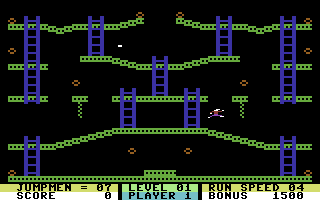
Arkanoid DS, however, manages to stamp on even on the rose-tinted glasses of those deluded souls. Vapid layouts combine with graphics that would embarrass a Commodore 64 to make a game that appears more dated than the mid-1980s arcade original. And if you’re waiting for me to say “but at least the gameplay remains intact”, you’re going to be disappointed: of all the Breakout-oriented games I’ve played, this is one of the worst. It’s too easy, far too dull, and you tend to get stuck for ages on the ‘last brick’, something hardly helped by the play area stretching across both DS screens and yet also being extremely narrow.

If Arkanoid DS was a homebrew effort, I wouldn’t be so scornful, but this is a commercial product. And when you compare it against Space Invaders Extreme, you see just how far Arkanoid DS is from being an exciting and essential update.

Arkanoid DS is out now, if you’re interested (read: if you’re a masochist). The Japanese version also comes with a little detachable DS paddle, but the game’s still rubbish.

Arkanoid DS

This is one of the best levels in Arkanoid DS. Seriously.

August 22, 2008. Read more in: Gaming, Nintendo DS, Rated: 1/5, Retro gaming, Reviews

Comments Off on Review: Arkanoid DS

Snippets for 2008-08-21

  • Rebellion’s bought Blackfish, publisher of Death Ray, which will now go quarterly. Rebellion also owns 2000 AD… http://tinyurl.com/5srr4r #
  • Most fun DS game of late: New International Track and Field. However, the throwing events are hateful (as in Zoo-Keeper-Quest-Mode hateful). #

August 21, 2008. Read more in: Snippets

Comments Off on Snippets for 2008-08-21

Review: Judge Anderson: Shamballa

Look into my eyes, the eyes, the eyes, not around the eyes

Rating: 3/5

Judge Anderson is an anomaly in the world of Judge Dredd. Moral, emotional, occasionally zany, and resolutely human, she offers a social conscience that sits in stark contrast to the head-cracking grimness of the monolithic Dredd.

As befitting a sometimes screwball character, what we have here is an oddball collection. Instead of Rebellion’s usual chronological fare with major characters, Shamballa offers a kind of ‘best of’, compiling stories illustrated by definitive Anderson artist Arthur Ranson (whose artwork also graced the excellent Button Man).

Although initially a foil for Judge Dredd, unnerving the square-jawed one with her flippant manner, Anderson moved in an overtly serious direction under Alan Grant, exploring the difficult subjects of child abuse and religion. The bulk of the ‘think of the children’ arcs are missing in this book, which instead largely concentrates on Anderson’s gradual understanding surrounding religion and faith—powerful ideas that the Judges seek to quash in the Godless world of Mega City One.

Within this book’s pages are Anderson’s two best tales. Shamballa chronicles Anderson leading a team of scientists beneath the Himalayas to try and stop cataclysmic supernatural events that are threatening the existence of the world. And Satan pitches Anderson against an evil, ancient being that at least thinks it’s the devil. However, because this collection cherry-picks Anderson’s adventures, it’s incomplete.

With a character like Judge Dredd, this might be less of a problem. But in this book, events are regularly witnessed out of context, and dialogue refers to things that you’ve not seen. A good example is lead story Shamballa: much of the emotional impact of the events resonates from the suicide of Anderson’s close friend Judge Corey. However, with the Corey story yet to see reprint, newcomers and lapsed readers will likely miss the significance of chunks of this book.

Despite its flaws, Shamballa nonetheless cements itself a place amongst the best Dreddworld books in Rebellion’s line. It’s just a pity so much of the story is missing.

Judge Anderson: Shamballa is available now for £15.99. For more information about 2000 AD graphic novels, check out the 2000 AD Books website.

Judge Anderson: Shamballa cover

Judge Anderson patiently waited for Dredd to return with the Nurofen.

August 21, 2008. Read more in: Graphic novels, Rated: 3/5, Reviews

Comments Off on Review: Judge Anderson: Shamballa

Snippets for 2008-08-17

August 17, 2008. Read more in: Snippets

Comments Off on Snippets for 2008-08-17

An interview with Mike Mignola, part six

Darkness calls

In a sense, you’re becoming a director for Hellboy, rather than having your finger in every single pie. How are you dealing with going from being in control of everything to being a scriptwriter?
Well, on one hand it’s great because you’re exposing Hellboy to a much wider audience—it’s the flip-side of this whole thing. More people are going to know the movie than are going to know the comic, but some of the people who see the movie will come and discover the comic. That’s one side of it—the great side. The other side is that a lot of those people are never gonna see what you do.

But at least you made up something that got out to the world—that’s pretty cool. And I’m one of those guys who erases ten lines for every line they draw, so for a while there, not drawing this stuff was actually kind of a relief… But what you start to miss is getting your hands in there, into everything. The thing that I’m constantly fighting against—right now fighting a losing battle, although hopefully I’m going to win it in the next year—is that you end up spending so much time overseeing so many different things that you don’t get any time to really focus on any one thing.

I’m writing Hellboy comics, co-writing a couple of other Hellboy-related things. I’ve worked on the animated films, and I was working on the live-action film. So I was spread pretty thin. I keep saying I’m gonna back off—I would love to get back to just going down every morning to the studio and writing and drawing something. But at the same time, I’ve kind of created this monster and have to keep feeding it. And if you have people saying they want the creator’s input, how can you say no?

Then you’ve got no real comeback if things don’t turn out the way you want.
The downside of that—and this is where I fully understand Alan Moore’s point of view—is that they say they want your input, but at the end of the day it’s their movie. So you might sleep a lot better saying “You want my input, but at the end of the day, you’ll change it, so why am I bothering?”

Fortunately, everything that’s been done with Hellboy has benefited from my input, because, in every case, a lot of people have listened to what I was saying. It wasn’t just that they wanted me as a marketing tool, to say the writer endorsed the property. But that’s because I’m working with creative people that respect what I do.

Where there’s another thing of mine that’s floating around in Hollywood right now, and if that lands with a director who I have no Del Toro-like connection with, I would probably do the same thing that Alan Moore does, although without saying to take my name off it. I’d say “Fine, it’s your thing. I did my version of it—the real version of it—and you’re going to go and make a film. It might be different to what I would have done, but go and do it. Give me the money and go and do it.”

The alternative is that you don’t let anybody play with your toys, you don’t let anyone have your property. But there’s always that chance of what if it works? What if they make a really great film?

Is it more important for you to just go for something, then, rather than perhaps regretting not doing so later? If something doesn’t turn out too well, I guess can always move on to the next thing, but without trying, you never know.
Well, as soon as Hellboy was optioned for a film, the first thing I did was go home and make up another character. This character was similar enough to Hellboy that if the film was so horrendous and people hated it so much that I could never go back to something called Hellboy—kind of like after Howard the Duck came out and it was like, “Oh no, you’ve poisoned this thing forever!”—I’d have had something to fall back on.

I had all these stories I wanted to do, and I needed a character where I could roll all those characters and stories over to this other character. But some mystery writer is credited with saying this thing about Hollywood where a reporter said “How do you feel that every time Hollywood makes a film out of one of your books, they ruin it?” and he replies “No, they didn’t—the books are just fine”. That’s the thing you cling to—the book’s on the shelf, and I’m looking at it right now.

This is why I can’t imagine just writing a screenplay and turning it over to Hollywood, because then no-one will know what you really wrote. Once it goes through the process, chances are it’s gonna change. I mean, a buddy of mine is just going through this in animation. He spent a year creating something for animation and it stalled someplace and it’s not being made. And I said to him, why don’t you do it as a comic first? You’re an animation guy, you can draw fast. Take a couple of months, draw a graphic novel or a couple of comics, and have them published. If the animation either doesn’t work out very well or it doesn’t happen at all, at least you’ve got something out there where you can show people something you made up. But making something up and being completely at the mercy of Hollywood—either to put it in a drawer or turn it into something else—is horrifying to me.

So what’s the future for Hellboy and for Mike Mignola?
Theoretically, what I keep saying is that next year I’m gonna get back to drawing some of my own stuff. And what I will keep doing is writing the Hellboy comic. Hopefully, I’ll be able to step in every once in a while and do five pages, but I’ve got my own stuff right now that I want to draw, a vague idea of what I want to draw and make myself.

I co-wrote and illustrated a novel [Baltimore: Or, the Steadfast Tin Soldier and the Vampire], and that worked out well, and so a couple of these other things I’ve made up along the line—things that would be a 200-page graphic-novel that I’m just not in a position to sit down and do—I like the idea of writing them up, handing them over to Christopher Golden and collaborating on more novels that I’d illustrate. And, yeah, I’d like to be able to focus my energy a little bit more and show people some new work that’s entirely by me.

Hellboy has a future. I’ve plotted it out to more or less the end of the series—or what could be the end of the series. My entire goal with Hellboy is to get to do the whole story. I’m not getting any younger! If I was trying to draw this thing myself, we’d never see the end of this story! Hopefully, I can get Duncan Fegredo to stick around to the bitter end of this thing. God knows if he’ll do it, but I’m really happy with the collaboration I’m having with him on the Hellboy stuff. So, yeah, I just want to finish that story.

That’ll be a somewhat rare thing to see in the world of comics: a lengthy story with a beginning, middle and end.
It’s one of the problems you run into in a mainstream comic—lots of them have the illusion of change, but because all these are huge properties owned by giant companies, they’re never really gonna let you keep a Superman dead, never gonna let you cut a Batman in half and keep half of him alive. But because I own Hellboy and control Hellboy—at least the comic-book version—I can make definite changes with that character, and they’re happening right now.

It’s actually very strange. After ten years of fumbling round in that Hellboy world, it’s now set on a certain course, and I’m starting to turn corners where once I’ve done that, I can’t go back. So it’s exciting—the story is going someplace. But it’s a little daunting when you go OK, we’re not going back there anymore!

The weird thing will be if Del Toro does a third Hellboy film, which would probably be the end of that film cycle. He would be doing the end of Hellboy ten years before I get to the end of Hellboy. The one thing I’ve got to be real careful of is that I don’t tell him how I plan to end the comic, because I sure as hell don’t want him to put it on film!

With thanks to Mike and Christine Mignola, and the guys at Dark Horse. The official Hellboy website can be found at hellboy.com.

Hellboy week navigation:
Intro | Part 1 | Part 2 | Part 3 | Part 4 | Part 5 | Part 6

Hellboy

August 17, 2008. Read more in: Graphic novels, Interviews

Comments Off on An interview with Mike Mignola, part six

« older postsnewer posts »