An interview with Mike Mignola, part three

The nature of the beast

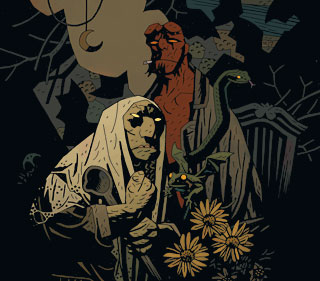
You have a very distinct way of drawing and inking—a lot of flat colour, plenty of light and shadow. How did your style come about?
The first artist I definitely wanted to be was Frank Frazetta, and I got ulcers in high school because I wasn’t as good as him. It took me years to realise not only was he much older, but he’s also kind of scary freakish good. But at least I was trying! And then I went through a phase where I really wanted to be Bernie Wrightson. The thing is, I was looking at really good guys, and I learned a lot. I studied their work, and then I went through a phase where I wanted to be everybody—every two days I wanted to be a different guy!

When I started working in comics, I realised you don’t really have the opportunity, because stuff’s done so fast, to figure out how so-and-so would have done this. Suddenly, you’re just working. What I found was all the people I wanted to be, all of the little pieces of inspiration, were floating around at the back of my head, and comics is a great place to learn how to draw, because you have to do so much of it.

All those styles start mixing together, and then it’s a case of just being really bad and trying to get better. Every job I did I hated, and so every new job I went into, I’d say this kind of worked, what if I did this with it, and I’d put too many lines here, so let me get rid of some of those, or the colourist messed up this, so next time I’ll just make that solid black and then they can’t wreck it…

There was a lot of that kind of stuff. I think there was at least ten years of just fumbling around, trying to figure out what I was doing before I started to feel like maybe I kind of do know what I’m doing. I’m still trying to figure a lot out. But at least the last ten years I’ve kind of gone, yeah, I guess that’s what this stuff’s supposed to look like!

And now your style’s being imitated by others!
And it’s very flattering! Mostly, people point it out to me and I don’t notice it. I notice it when someone makes the same mistakes I do. If someone does it really well, I go, wow, that guy can really draw… But if he’s doing it badly, I go woah, he got mixed up by the way I do this or this.

I think because I’m influenced by so many different people, the nice thing is no-one can look at my stuff and say I’m doing an imitation of so and so. You don’t want to be the third-best ‘this guy’ or 15th-best ‘that guy’, which unfortunately is what you see a lot of in comics. So when I see people influenced by me, the one thing I’m hoping is that it’s a phase they’re going through and eventually they’ll evolve into their own guy.

During Hellboy’s early years and up until recently, you’ve done almost everything yourself—most of the art and writing—but most comics creators script or illustrate. So how does it feel to have that much control over your creation, and how did it feel when others took over?
It’s interesting because I started out as a guy inking other people, but I was terrible at that so I started drawing other people’s stories. Even when it came to doing Hellboy, I never wanted to write this stuff. I liked making up the stories, but I loved the safety net of having a real writer that’d come along and put the words in there.

John Byrne came along and co-wrote Hellboy with me, because my plan when I talked about doing Hellboy was that I’d just make up the character and a list of stuff I wanted to do—this laundry list of things I wanted to draw—and give it to John to knock into a story. But at that point, I was making stuff up pretty fast, and little by little I was piecing the story together, before I could give it to John, and then John just came in to script it.

Then I’d send artwork to John and have to write in what everyone was saying, because he didn’t know what the story was. So I kind of wrote it, and gave it to John to rewrite. What I then found was there were places where he changed what people were saying and I went hmmmm. It sounded more polished and professional written by John Byrne, but I liked the oddness to the way I wrote it. Some of the quirks and humour didn’t translate.

John knew this, and I was actually editing him as we went through the first Hellboy miniseries. John would always say to me that I should be writing the book. To his credit, John never tried to make this his book or even our book—he always treated it like he was the training wheels on the bicycle, like he was there to help me out. And I can’t thank him enough for that, because at the end the miniseries he said “you’re on your own—you don’t need me!”

So I got to practice writing the book, and then the scariest moment was when I took over the next one, drawing and writing myself. Because I’d never been faced with a situation where everything on the page was gonna be me. And the second Hellboy story was published in black and white, so I didn’t even have a colourist to come along and make it look like a professional job!

But what I found once I relaxed into it a little bit was that there were so many things I could do as the writer and the artist together. So often when you’re working with a writer or an artist, you kind of trip over each other. One guy overstates something, or the writer over-explains something, or the artist doesn’t quite understand what the writer was asking for. But because I was in charge of that vision, I found there was this whole set of tools that I didn’t even realise existed.

To let that go here for a while where I’m turning over Hellboy to someone else to draw… Frankly, it’s been really difficult, because I’ve had to explain to someone else what I’m thinking. I’m so used to knowing what I’m thinking when I’m writing the stories. I know what I’m going to do as an artist, and when I’m drawing, I know pretty much what the writer was thinking. But to have to sit there and write a script where I have to explain everything to somebody else, I always back it up with a phone call to make sure they know that the hell I’m talking about!

What’s happened is that I’ve been writing these past couple of years, and I’m really getting that itch to go back and draw and write some stuff myself, because it’s the real thing. There’s so much interesting stuff you can do when you’re doing it all yourself.

When I go back, it’ll be to do some really odd stuff. I’ll step in periodically to do bits here and there on Hellboy, but I wanna do some stuff that’s more experimental where I’m playing a little more with the artform.

With thanks to Mike and Christine Mignola, and the guys at Dark Horse. The official Hellboy website can be found at hellboy.com.

Hellboy week navigation:
Intro | Part 1 | Part 2 | Part 3 | Part 4 | Part 5 | Part 6

Hellboy

August 14, 2008. Read more in: Graphic novels, Interviews

Comments Off on An interview with Mike Mignola, part three
An interview with Mike Mignola, part two

Strange places

With Hellboy, where does your inspiration come from? There’s a real mix of mythology, horror and fantasy.
The first couple of Hellboy books are like an explosion—everything and the kitchen sink is thrown in there, because who knew how long I was going to get a chance to do this? I just wanted all the things I’d ever wanted to draw in the book. I only planned on making up one thing, so I wanted to make sure that everything I wanted to do was in there: pulp-magazine horror stories, b-movies, horror-movie kind of stuff… everything from that to Victorian-era ghost stories… So, basically, everything I’d ever read, everything I’d ever seen, was the inspiration for Hellboy!

And then once I got through the big explosion of stories, the thing I gravitated towards was the folklore. The pulp stuff is really fun to write, but I’ve always loved—since I was a little kid—European folklore. I think it was at the third or maybe even the second story I did, I wanted to do a werewolf story, and it was just a matter of doing enough research and enough reading about werewolves and looking for some kind of folklore hook that I could base the story around. That Hellboy story was almost a straight adaptation of an Irish folk tale.

I’d always wanted to do something with folklore, and I’d actually planned on doing straight adaptations of these tales, but I realised that once I did Hellboy, and once I realised people liked Hellboy, I could do these same stories, but using Hellboy as a device to get people to read them. If I did straight adaptations of Irish folk-tales, it would narrow the audience tremendously, but Hellboy injects this nice ‘everyman’ appeal, even though he’s the beast of the apocalypse, and this is a good way to deal with these old-fashioned stories.

What is it about these folklore stories, myths and legends that really grabs you?
I have no idea. When I was a little kid, I read Dracula, and I said this is a world I wanna live in—obviously not really with him—but this is my kind of subject matter. And there’s always been something about not just gothic literature but folklore and myth that that I’ve found fascinating.

I think one of the things I love about it is that there’s an element of the absurd—in the stuff I like anyway. There’s stuff that happens where you just go: “wow, there’s no way in hell I’d have made that up! It’s like, I don’t know why that works, I don’t know why that happens, but the beauty of that stuff to me is that it does happen.

For some reason, somebody made up a story where the Russian witch Baba Yaga sneaks into a guy’s house every night to count his silverware. God knows why, but there’s some other logic going on—something I always refer to as ‘fairy-tale logic’. Things just happen and you go: yeah, OK, I buy that, even if I don’t understand it.

In doing supernatural fiction, I find that one of the most important things is that there has to be that element of not understanding why things that are happening are happening. As soon as you understand them, they become science-fiction. There’s gotta be that thing where we don’t know what the rules are, with no regular kind of logic to it. It’s that kind of strangeness that I find really endlessly fascinating.

I guess that’s also a good reason for keeping Hellboy grounded?
There’s a schizophrenic nature to writing Hellboy. I listen to a lot of Shakespeare and old Bible films, and so I have a tendency to write in probably a very bad way, where everyone speaks in that kind of rhythm—especially when dealing with the king of the fairies, or the ghost of Rasputin. They tend to speak in this Biblical or Shakespearian way.

What I find is that I write a couple of pages of that and become really embarrassed by what I’m doing. Hellboy is that part of me that is my father’s son that says “What the hell are you doing?” Hellboy’s the guy that’ll come in and deflate that, and let the reader know that I know that the other thing is kind of silly. That’s been the formula that works real well.

So Hellboy brings things down to Earth, if someone’s finding things becoming a bit much for them?
Being an inexperienced writer, the only way I knew how to write my main character was to think what I would say, and that’s worked pretty well. He’s got my sensibilities, he’s got a little bit of my sense of humour, and he’s also got my father’s real blue-collar working-stiff attitude about things.

With thanks to Mike and Christine Mignola, and the guys at Dark Horse. The official Hellboy website can be found at hellboy.com.

Hellboy week navigation:
Intro | Part 1 | Part 2 | Part 3 | Part 4 | Part 5 | Part 6

Hellboy

August 13, 2008. Read more in: Graphic novels, Interviews

Comments Off on An interview with Mike Mignola, part two

An interview with Mike Mignola, part one

Wake the devil

What first got you excited about comics?
Boy, I don’t think I’ve ever been asked that! My cousin was a comic-book reader, and I was exposed to great Marvel comics—Stan Lee, Jack Kirby stuff—when I was really young, and while I didn’t really become a comic book collector until later, like in junior high school, the bug kind of hit me early that there was this whole world I was unaware of. As I got a little older, I sort of rediscovered this stuff I’d been exposed to as a young kid, and I was just hooked.

What was it that appealed to you? Was it about getting away from reality?
Yeah, it was a real spectacular kind of fiction—there’s the art and the story, and I was drawing since I was tiny, and so the art obviously appealed to me—but it was mostly the mythology.

So what inspired you to go from being a fan to writing and creating your own stories?
From an early age, partly fuelled by comics, but also from the books I started reading, I always loved the supernatural—I always loved monsters—and as I went through art school, my goal was to somehow make a living drawing monsters. There aren’t a lot of jobs doing that! [laughs] And I’d actually gotten out of comics, and wasn’t really following them at that point.

I was gearing myself towards becoming an illustrator, but at some point you realise there aren’t a lot of jobs for an illustrator that wants to draw monsters. So as I came out of art school, I started looking at comics again as a place where I could get away with drawing monsters. I didn’t think I was good enough to draw comics, but I though that by getting in there and inking other people’s work, slowly, little by little, I would eventually be able to get a job in comics, drawing covers or something like that.

I thought that was the only outlet for what I wanted to do. It never even occurred to me to write my own stories at that point. I was in the business for ten years before I started even playing with the idea of writing my own stuff.

What prompted you to start writing?
Well, after ten years in the business, drawing a lot of stuff that didn’t have monsters in it [laughs], I realised that the only way I was going to get to draw the stuff I wanted to draw was to make it up myself.

There was actually a Batman story that I wrote with someone else, but it was my idea, so basically “here’s a list of the things I wanna draw”. I drew it and someone else scripted it, and it was a lot of fun.

Suddenly, I was sitting there thinking that was kind of nice, getting to do my subject matter, so why don’t I, instead of making up other weird stories like this and trying to stick Batman or some other established characters into them, make up my own characters specifically for the purpose of doing these kinds of supernatural stories?

I knew the kinds of stories and subject matter I wanted to do, so then it was just a matter of making up a character to base these stories around. Hellboy isn’t a character I’d planned to do—not something I’d made up as a little kid. I’d done one or two drawings of a character kind of like him, and on one drawing I’d tacked on the name Hellboy, just as a joke.

I actually wanted to do a cult detective kind of character, and I would have made him a regular human being, except I knew I’d get bored drawing a regular human being, and so I just thought why not take this fun monster and make him my main character, because I won’t get bored drawing him!

With thanks to Mike and Christine Mignola, and the guys at Dark Horse. The official Hellboy website can be found at hellboy.com.

Hellboy week navigation:
Intro | Part 1 | Part 2 | Part 3 | Part 4 | Part 5 | Part 6

Hellboy

August 12, 2008. Read more in: Graphic novels, Interviews

Comments Off on An interview with Mike Mignola, part one

Hellboy week on Revert to Saved

A six-part interview with Mike Mignola this way comes

A few months ago, I was lucky enough to speak with Mike Mignola about his work in comics and the film industry. He provided insight into his illustrative style, the inspiration for his Hellboy work, and what it’s like to see your creation move to the big screen. Since the bulk of the interview never saw the light of day, due to the restrictions imposed by limited space in magazines, I thought I’d run the interview over the next week or so, to whet people’s appetites for the British release of Hellboy II: The Golden Army.

So check back over the coming days for one of the most comprehensive interviews with comics legend Mignola that you’re ever likely to read.

Update: all six parts are now online—Intro | Part 1 | Part 2 | Part 3 | Part 4 | Part 5 | Part 6.

Mike Mignola

August 12, 2008. Read more in: Film, Graphic novels, Interviews

Comments Off on Hellboy week on Revert to Saved

Snippets for 2008-07-31

  • Garfield minus Garfield is getting a book, with the original comics alongside the doctored ones: http://tinyurl.com/4ul2wv #
  • PerversionTracker is back, showcasing the very worst of Mac software, concentrating on iPhone dreck. http://perversiontracker.com/ #
  • Judging by comments for some of my recent online articles, the word ‘faff’ isn’t universally known. My mission is to change this in 2008! #

July 31, 2008. Read more in: Snippets

Comments Off on Snippets for 2008-07-31

« older postsnewer posts »