To AV or not to AV—the battle for political reform in the UK
After the 2010 UK general election, I made this:
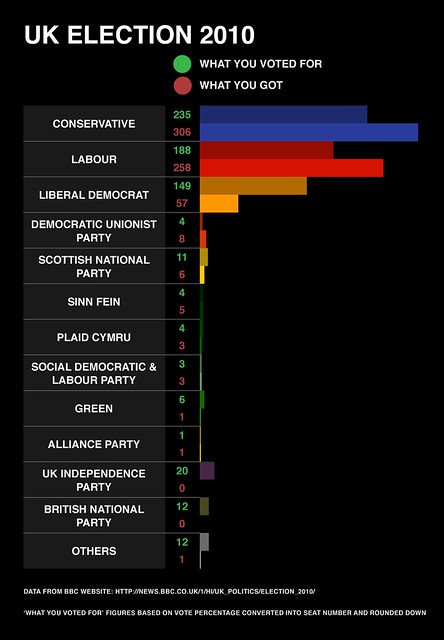
It shows what we voted for and what we got. As you can see, what we got was, as usual, not terribly close to what we voted for. Now, we have a chance for change, but, as usual in the UK, it’s not change anyone wants. We’re going to get the option to replace the awful first past the post system with the barely superior alternative vote.
The BBC sums up the parties’ stances, and it makes for bonkers reading. In summary:
- The Conservatives want to stick with FPTP, although most Tory MPs don’t think AV would make any major difference to their party.
- Labour, now finding itself in opposition and with its seeming self-enforced policy of always having to play reactionary politics, is supporting AV. Again, AV won’t make much difference to Labour.
- The Liberal Democrats are in favour of electoral reform, but really want STV (single transferrable vote), not AV.
- The SNP is undecided but its leadership says it really wants STV rather than AV.
- Plaid Cymru supports electoral reform and backs AV, but wants STV.
- The DUP will back AV, but wants STV.
- The Green Party will support AV, but wants voters to be able to choose between a range of systems and favours “a fair, inclusive proportional way of voting”.
- UKIP is backing AV, but wants AV+.
- The BNP hates AV almost as much as the French and will campaign against, and favours “proportional representation”.
- The English Democrats, Christian Peoples Alliance, Respect, Jury Team and Communist Party all want a proportional system, and have varying stances on AV.
Reading through that, it’s pretty clear what’s going on and what’s going to happen. FPTP favours those in power, hence the Tories campaigning against AV. AV isn’t a big enough change to make any odds to big parties, hence Labour campaigning for AV, largely to piss off the Tories. For smaller parties, everyone wants a proportional system, so most are backing AV in the hope that it’s a first step towards one.
I’ll bet what’s going to happen, though, is that the Tories, backed by the aggressive and right-wing element of the UK press, will give the AV campaign a serious kicking until the day of the vote. We’ll hear a lot about how poor the coalition has been and how any change to the electoral system could result in more coalitions. (Never mind that the one coalition we’ve had in recent history was, seemingly, supposed to be magical and perfect, yet all the shitty UK governments elected by FPTP haven’t led people to go: “You know what? FPTP is rubbish.”)
Despite this, AV has a chance, because it’ll be backed by almost every non-Conservative party and some major press, and so it might win. But at that stage, we’re done. This won’t be a stepping stone, because Labour at that point will shut up shop. Labour knows that it’d be much harder to win 2015’s election under any form of PR, and so we’d be left with support for further change in the hands of the Liberal Democrats (who almost everyone in the UK now hates) and small parties that are either bonkers (hello, BNP!) or who make sense but have relatively little voice (nationalists, The Greens).
Personally, I’d love to see the UK finally embrace democracy in a very real way and so I’ll be supporting AV, and clinging to the sliver of hope that it’s a stepping stone and not a full stop. It’d be great to show up at the election booth in 2015, knowing that—for the first time in my adult life—my vote actually mattered. I just can’t see it happening though.
If the Coalition and assorted experts can’t even agree on the question to be asked in the referendum, it’s no wonder it’s doomed to fail – even with a vigorous campaign on both sides.
The BBC’s Q&A on what it actually means was also very well written. It’s basically the system Labour used to elect Ed Milliband… but don’t let that put you off. Here is a once-in-a-generation chance to actually change the system. It may not be the perfect change (STV or true PR would have been my preference) but it is a real CHANCE to make votes be worth more.