How Windows Explorer in Windows 8 hasn’t learned to say no

During the spate of articles about Steve Jobs stepping down as Apple CEO, one of the major aspects of his success was put down to an ability to say no. This leaves Apple products with fewer features than those from its rivals, but, typically, superior usability and focus. The blog post Improvements in Windows Explorer rather starkly highlights the opposite approach. It traces the lineage of Microsoft’s file manager, from its hideous beginnings in Windows 1.0 through to the arrival of sanity in Windows XP. But then you get to Windows 8.

Over the years, Explorer has grown to support a number of different scenarios, many unrelated to file management – launching programs, viewing photos, playing videos, and playing music, to name just a few. We wanted to know which of these capabilities customers were really using. Using telemetry data, we were able to answer the question of how the broadest set of customers use Explorer in aggregate. As a reminder, the telemetry data is opt-in, anonymous, and private, but it does represent hundreds of millions of sessions from all customer types.

This data is pretty interesting. First it shows that even though there are over 200 commands in Explorer, customers use a small number of them with any real frequency: the top 10 commands represent 81.8% of total usage. Additionally it shows us that people overwhelmingly use Explorer for core file management tasks – the top 7 commands (72.2% of usage) are all for managing/manipulating files.

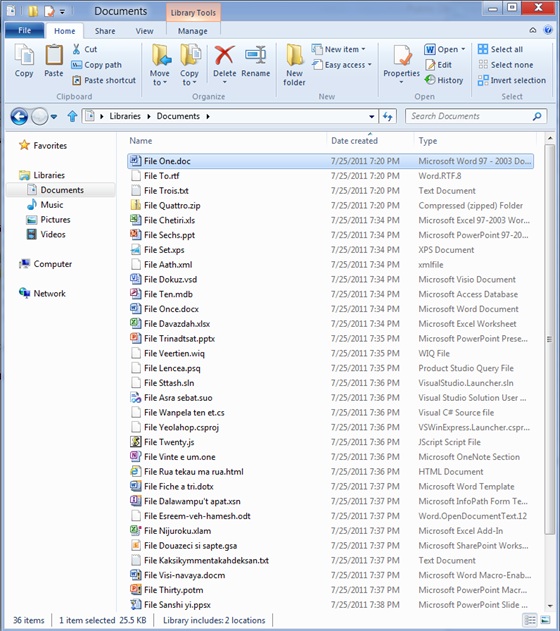
Apple’s clearly done similar testing with its applications over the years, in an effort to streamline. Finder has, if anything, simplified during OS X’s evolution. Therefore, it seems someone removed logic from the equation in allowing Microsoft’s Explorer team to do this:

Windows Explorer

To be fair, the Ribbon can be hidden in Explorer, and that’s just as well, because Microsoft’s created a horrible mess that will intimidate newcomers: instead of concentrating in the “top 10 commends [that] represent 81.8% of total usage”, this new interface flings tons of options in your face. It’s also hard to tally this vision of the future of computing not only with Apple’s iOS but also Microsoft’s own Windows Phone OS, which is currently being smashed into Windows 7 with a hammer, to create the hybrid OS that Steve Ballmer seems to think everyone wants.

Perhaps Microsoft will emerge victorious. Maybe people really do want to run the ‘full’ version of Excel on a tablet device rather than the sleek and simpler Numbers on an iPad. But I’ve a sneaking suspicion the kind of craziness and chaos showcased in the Microsoft blog post rather shows the opposite. It’s complexity for the sake of it, and showcases an inability to say no to including something, ‘just in case’ a few users might need it.

September 1, 2011. Read more in: Apple, Design, News, Opinions, Technology

1 Comment

My Neighbor, Steve Jobs

By Lisen Stromberg, some memories of Steve Jobs, her neighbour:

While Newsweek and the Wall Street Journal and CNET continue to drone on about the impact of the Steve Jobs era,  I won’t be pondering the MacBook Air I write on or the iPhone I talk on. I will think of the day I saw him at his son’s high school graduation. There Steve stood, tears streaming down his cheeks, his smile wide and proud, as his son received his diploma and walked on into his own bright future leaving behind a good man and a good father who can be sure of the rightness of this, perhaps his most important legacy of all.

The tech press too often forget there’s a person in there, and they’re already doing the same with Tim Cook, spending far too much time focussing on whether or not he’s gay and demanding he confirm either way because, damn it, he just should, OK (because the revelation will get a fuck-ton of page views and yet still not stop all kinds of unwarranted speculation). Time for the tech press to grow the hell up and show some respect, rather than romping headlong into tabloid territory.

So: rousing applause for Stromberg; slow-hand clap for a good chunk of the rest of the industry.

September 1, 2011. Read more in: Apple, Opinions

Comments Off on My Neighbor, Steve Jobs

Apple kills TV rentals, while studios roll in piles of imaginary money

Fucking hell. That nicely sums up my reaction to AllThingsD’s article stating that Apple’s canned TV rentals. Being British, a mystical place called ‘overseas’ that whoever does Apple’s media deals isn’t entirely sure actually exists and therefore largely ignores, I had to use a sneaky US account to access TV rentals on the Apple TV. And here’s what happened:

  • 48 episodes of Lie to Me rented ($47.52)
  • 48 episodes of Castle rented ($47.52)
  • A bunch of miscellaneous rentals of Grey’s Anatomy and random other shows (about $100)

Without Apple TV rentals, we (Mrs G and I) would have probably never discovered and watched Lie to Me. Grey’s Anatomy… we were acquiring that by ‘other means’ before the 99-cent rentals rendered that pointless. And Castle? Well, we love Castle, but not enough to spend loads of cash on it. We’d have waited for the inevitable DVD firesale in the UK or US and picked it up for bugger all—and certainly than for less of the price of the iTunes rentals.

Apple’s laughable spin is that “customers have shown they overwhelmingly prefer buying TV shows”, but that’s bullshit. While reaction to my complaints about Apple binning TV rentals on Twitter shows this is certainly the case for some people, it isn’t for others; more likely, the studios holding back their content was to blame, leaving the rental selection in a pitiful state, especially towards the end. And at the same time the likes of Warner Bros. were arguing 99-cent rentals devalued their content, they were of course allowing Netflix users to download as much as they liked for eight bucks per month. Classy.

So, where does this leave anyone who loves TV? Well, you now have the following choices:

  • Pay for hugely expensive cable or satellite, which gives you tons of crap and a few shows you actually care about.
  • Pay over the odds for shows on iTunes: £2.49 ($4) per HD episode, in the UK.
  • Grab waste-of-resources Blu-rays or DVDs when they show up or, if you’re savvy, hang on for the sales, and then try to figure out how to fit your ever-growing collection in your home.
  • Visit the naughty web and say “screw you” to the studios.

Me, I’ll probably head for the third of those options now, but I’m sorely tempted by the fourth. The thing is, I actually want to pay for good shows and support those who make them, but the studios aren’t making it easy. I’m not paying twice as much for a series of House on iTunes as it costs on DVD, but I’m also not exactly thrilled by the prospect of buying more discs-in-card-boxes that waste resources and take up space. I also don’t really care to download content that I then ‘own’ and that takes up hard drive space when I only watch the vast majority of shows once. (Note to US readers yelling “But what about iCloud?”, Brits will only get app and book sync initially—we’re left out of the media-streaming excitement.)

So, yeah, thanks, Apple and thanks, greedy studios. Maybe one day the studios will wake up and realise that 99p or so would be a sensible price-point for a TV show, but I won’t hold my breath. (Even many games companies don’t seem to understand that popular products sell way more copies when they’re cheap, otherwise Pac-Man would always be 69p, rather than rather more ambitiously priced.) Also, take this surrender by Apple as a possible shot across the bows regarding digital movie rentals. As I said a couple of weeks back, they’re now being removed from iTunes with alarming speed, to drive up purchases that are often costlier than grabbing a DVD. It wouldn’t shock me if Apple quietly decides to trash that aspect of the iTunes Store, while being strong-armed by the studios, under the excuse that people want to ‘own’ their movies.

August 26, 2011. Read more in: Apple, News, Opinions, Technology, Television

Comments Off on Apple kills TV rentals, while studios roll in piles of imaginary money

Katherine Noyes knows how to save Apple from itself

I’ve written about PCWorld writer Katherine Noyes before, responding to her bleating on about how rubbish tablets are, but today she’s decided, in the wake of Steve Jobs resigning, she knows what’s right for Apple:

Now that Jobs has stepped down, however, Apple has a great opportunity. Rather than maintain its completely closed and locked-down approach to the technologies it makes, the time is right for Apple to open up. Besides creating a more sustainable strategy for Apple, such a move would perform a great service for consumers, businesses and the world.

Fair enough, Katherine. Maybe if Apple takes your advice it might just make great products that loads of people buy, leading to profitability, longevity and—if it’s very lucky—becoming one of the biggest companies in the world.

What?

August 26, 2011. Read more in: Apple, Opinions, Technology

Comments Off on Katherine Noyes knows how to save Apple from itself

Non-stupid people respond to Steve Jobs stepping down as Apple CEO

In the hours since it was reported Steve Jobs had resigned as Apple CEO, reaction has been mixed. Apple’s shares are down, as investors panic, despite Apple being in the strongest position it’s ever been in, and commentary ranges from APPLE IS DOOMED through more sensible takes on Apple’s future. Since the internet is prone to hysteria in return for page hits, I’d like to buck the trend and offer a post dedicated to smart, savvy commentators that talk about how Jobs positively affected Apple, the current transition to new leadership, and what the next few years might hold for the company.

Something that’s now commonplace in tech reporting is an ability to understand Apple’s disruptive influence on the tech industry. Saul Hansell for TechCrunch notes that recent events starkly highlight Apple’s impact:

As recently as 2002, personal computers were seen as such a commodity business—dominated by high volume and low costs—that Hewlett Packard paid $25 billion to buy Compaq and vault past Dell to be the No. 1 in the market. Last week, HP, still the leader, said it is considering abandoning PCs altogether, at least partially a concession that Apple was taking an increasing share of the market and most of the profits.

However, what’s less common is an appreciation that Apple rarely comes up with new things. It’s a company of refinement, as journalist Kenny Hemphill explains:

Some saying that ‘predicting the next big thing’ is where Jobs will be missed. Apple never predicted next big thing. It created it though not always from scratch. Often it just takes existing ideas and builds products the way they should have been built [the] first time.

And there’s no reason why such savvy refinement can’t continue with Cook as CEO. As Ian Betteridge points out:

Looking at Apple’s [senior management team], it’s still the most talent you’ll get in a single room in Silicon Valley.

Regardless, people worry about Cook. They think he lacks that spark of creative genius that Jobs has, or fret that Apple in his hands will somehow nosedive when he finds himself in control. As John Gruber of Daring Fireball says, they forget that Cook’s effectively been running Apple for some time now:

The thing to keep in mind is this: Apple tomorrow, a week from now, and next month is the exact same Apple from yesterday, a week ago, and last month. Tim Cook wasn’t named ‘CEO’ until today, but he’s been the chief executive at the company since Jobs started this — his third — medical leave back in January, and probably even before that. Whatever Steve’s role is going forward, it’s only different in title than what it has been, in effect, for some time.

And developer Wil Shipley warns against underestimating Cook’s role in Apple’s current success:

Years ago, when I was still invited to sit in VIP section of Stevenotes, Apple was introducing a new product. […] The audience was shocked at the performance AND the price. I turned to the Apple executive next to me, and whispered “What? How is it so cheap? That’s better than competitors! Apple’s never been cheaper. How did this happen?” Exec said two words: “Tim Cook”.

Of course, Jobs isn’t actually gone, although as designer Tom Muller says, you might think otherwise from some of the reports on major websites today:

Interesting to see people equate a stepping down in one role to take up another with being jobless or retirement.

Harry Marks also points out that, really, while we’ve seen a change at Apple this past day, it’s not as big a change as you might think:

Steve Jobs stepping down as CEO doesn’t mean he isn’t going to be a part of the company. It means he won’t be dealing with much of the bureaucratic bullshit that goes along with the title. Jobs is still (for the present time) going to be an active part of Apple.

Marks echoes Betteridge in also noting the strength of Apple’s executive team:

Steve Jobs is a very smart man who has surrounded himself with very smart people, like Tim Cook, Phil Schiller, Scott Forstall and Jony Ive. I have complete faith that no matter what happens, we’re still going to get the same great products we always have

Speculation continues regarding the reasons why Jobs stepped down, though, and his health must be a factor. So what happens if Apple one day soon finds itself totally without its visionary leader? Potentially, relatively little, according to Gruber:

Apple’s products are replete with Apple-like features and details, embedded in Apple-like apps, running on Apple-like devices, which come packaged in Apple-like boxes, are promoted in Apple-like ads, and sold in Apple-like stores. The company is a fractal design. Simplicity, elegance, beauty, cleverness, humility. Directness. Truth. Zoom out enough and you can see that the same things that define Apple’s products apply to Apple as a whole. The company itself is Apple-like.

Cult of Mac’s Leander Kahney agrees with this viewpoint:

Steve’s resignation will have no effect on Apple in the short term. There’re a couple of years of products already in the pipe. On the one hand, he’s obviously irreplaceable. But he’s also molded Apple in his image. His DNA is so firmly embedded in the company, it will run like clockwork without him.

Kahney admits that he could be wrong, but his guesswork seems reasonable. And Macworld’s Jason Snell thinks due to Jobs’s hard work, there’s little to worry about regarding the company’s future:

The Apple of today is hugely profitable, with tens of billions of cash, a 90 percent share of the tablet market, a rapidly growing smartphone business around the world, and the only truly profitable personal-computer franchise left. This is where Steve Jobs leaves Apple as CEO: on top, with momentum to carry it further up.

That said, he does add a splash of harsh reality:

No company is guaranteed survival. The technology industry is ruthless and the pace of change keeps accelerating. But if there’s a company that’s in a position to survive and thrive even without Steve Jobs as the CEO, it’s Apple. Now it’ll be up to Tim Cook and his team to make sure the company sticks to the playbook.

And the best tribute any Apple fan can make to Steve Jobs’s tenure as CEO of one of the most brilliant companies to date? I’ll leave that to developer Duncan Wilcox:

In life everything eventually comes to an end. We stand on Steve’s shoulders, we’ll make him proud of us. Now go design, innovate, disrupt.
August 25, 2011. Read more in: Apple, News, Opinions, Technology

Comments Off on Non-stupid people respond to Steve Jobs stepping down as Apple CEO

« older postsnewer posts »