Tim Langdell gets a spanking from UK judge in battle with Future Publishing over Edge

John Walker’s coverage of Tim Langdell’s latest disaster is gold for anyone who’s been following the case. And if you feel any pity for Langdell, don’t. Over the years, he’s had numerous developers and creatives claim they’ve not received payment, bullied dozens of companies into paying him over marks he couldn’t defend, sued indie developers (and other companies) who had the audacity to use the word ‘edge’ somewhere in their product names, provided inaccurate submissions to the USPTO in order to get marks, lied to courts in the US and UK, and claimed to have ‘spawned’ Edge magazine and numerous other products (including, bizarrely, a Marvel comic). Additionally, it’s revealed in Walker’s story that Future paid off Langdell in 2004, to the tune of $275,000, in order to get him to shut the hell up and go away. In return, he cunningly carried on claiming to have invented Edge, including a US version, and said he’d designed the Edge logo and that Future ripped him off. Shameless. On the plus side, the section about the 5.25-inch disk in Walker’s piece is a fantastic read and great advice on what not to do if you’re ever involved in a court case relating to IP issues.

Maybe Lodsys, currently suing pretty much the entire world, should take note. Langdell survived when he went after the small guys, but by becoming prominent and biting off more than he could chew (i.e. EA over Mirror’s Edge and Future over Edge magazine), he’s been given international spankage. I rather hope the same happens to Lodsys.

Note: for the full bonkers Langdell story, Chaos Edge is your best bet.

June 17, 2011. Read more in: Gaming, News, Opinions

Comments Off on Tim Langdell gets a spanking from UK judge in battle with Future Publishing over Edge

Tap! magazine 5 iPhone, iPad and iPod gaming special

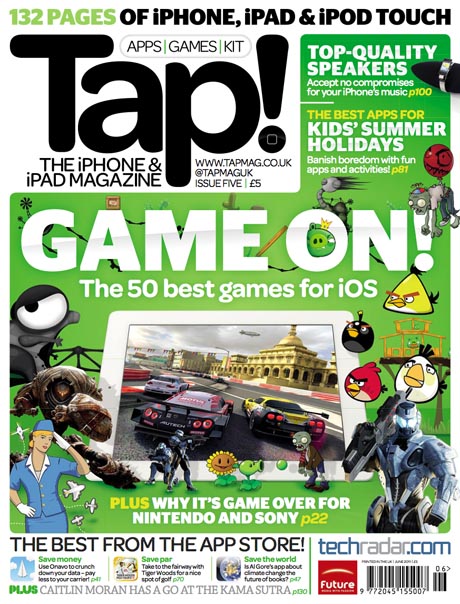
Regular readers of Revert to Saved may remember that I’m Contributing Editor to Future Publishing’s rather fab Tap! magazine. The title is dedicated to iPhone, iPad and the iPod touch, and I’m responsible for its games section. For issue 5, editor Christopher Phin tasked me with writing a cover feature about iOS gaming, covering the best available games, what games designers think about the platform, exploring kit, and offering the odd nod to retro-gaming. Designer Chris Hedley then created one of the best covers I’ve seen on a consumer tech mag, featuring a ton of iOS gaming characters.

Tap! 5

The magazine of course also includes all the usual iOS news, reviews, tutorials, features and columns. If you’re a UK subscriber, you should get your copy within the next couple of days (if it’s not already arrived). Alternatively, the magazine should be on newsstands (WHSmith, Tesco and other stores) some time during the next week.

June 6, 2011. Read more in: Apple, iOS gaming, News, Tap!

Comments Off on Tap! magazine 5 iPhone, iPad and iPod gaming special

Charlie Brooker on entitled idiots whining about iPhone games that cost 59p

Charlie Brooker, in his latest piece for The Guardian:

Look at the App Store. Read the reviews of novelty games costing 59p. Lots of slaggings – which is fair enough when you’re actively warning other users not to bother shelling out for something substandard. But they often don’t stop there. In some cases, people insist the developers should be jailed for fraud, just because there weren’t enough levels for their liking. I once read an absolutely scathing one-star review in which the author bitterly complained that a game had only kept them entertained for four hours.

FOUR HOURS? FOR 59P? AND YOU’RE ANGRY ENOUGH TO WRITE AN ESSAY ABOUT IT? ON YOUR EXPENSIVE IPHONE? HAVE YOU LOST YOUR MIND?

He says this is human nature, with technology having left us hopelessly spoiled. I say people should get a sense of perspective, because their incessant moaning about App Store games is ridiculous. I wonder how many of these idiots whining about a good 59p game that provides four hours of entertainment have ever bought a game on another platform (such as the Nintendo DS, with its carts costing 15 quid a pop or more), or back in the days where you took a punt on an Amiga game for 25 quid. Even in the mid-1980s, the era of the C64 and ZX Spectrum, the absolute cheapest games were £1.99, came on cassette, and were—proportionately speaking—often as bad as the worst 59p iPhone ‘specials’, with the odd gem randomly lurking in the mix.

Four hours of fun gameplay for 59p isn’t something to complain about—it’s something that should be celebrated.

June 6, 2011. Read more in: Apple, iOS gaming, Opinions, Technology

1 Comment

A quickfire review of the iCade games controller for the iPad

Touch Arcade just reviewed the iCade, and made a bunch of points I agree with, but some that I vehemently disagree with, notably

I found tearing through these classic games [in Atari’s Greatest Hits] on the iCade to be everything I’d hoped it to be. On the whole, it’s just an awesome experience

and

As far as I’m concerned, the iCade (along with Atari’s Greatest Hits) is an absolute must-have iPad accessory for the serious retro gamer.

But I’m getting ahead of myself, so QUICKFIRE HISTORY MODE!

In April 2010, wags at ThinkGeek announced the iCade, but, alas, it was April 1, stupid face! Duh! But heros in the distance emerged in the shape of ION Audio, who went “man, that’s a great idea”, licensed the design and made it a real boy.

I got to play with an iCade while working on issue 5 of Tap! magazine, and my review unit came pre-assembled, so I’ll have to take Touch Arcade’s word for how easy it is to put together. Touch Arcade’s bang-on about the unit itself, though:

  • The iCade feels weighty and robust. It feels like it could stand up to a lot of fairly heavy gaming.
  • The buttons have a great feel to them, and click in a very satisfying manner.
  • The stick’s travel is too long (and my unit’s one ‘stuck’ in the left position quite a lot), but is nonetheless reminiscent of arcade sticks of old. (I always used to play games with a Competition Pro, which had a lower travel and was therefore more responsive.)
  • The iPad sits very nicely within the unit in portrait mode, although you need to watch the surprisingly heavy lid doesn’t snap down on a finger, like it did on mine. (Ouch.)
  • In landscape mode, the iPad perches a little precariously in a small ridge.
  • Set-up/pairing with the iPad was reasonably simple, although in my case it took a few attempts.

The problem I have with the iCade as it currently stands is the games—well, app (singular) Currently, iCade only works with Atari’s Greatest Hits, which is a compilation I’d call middling if I was being charitable. The compilation includes a bunch of Atari 2600 games, which aren’t emulated correctly and only play in portrait (wasting loads of screen space), along with a selection of arcade hits, most of which were specifically designed by Atari to have unique control systems. You can see where this is going, can’t you?

In use, the iCade itself is actually pretty good, but the experience of the only compatible piece of software is not. Atari helpfully leave some of the interface behind, so you get to watch a giant pause button along with your game, but it helpfully removes the gigantic virtual joystick, leaving a huge blank space under the game. Had Atari enabled landscape mode for Atari 2600 games, I might have overlooked the shortcomings in emulation (major colour problems in some games, poorly emulated sound), but the entire thing felt more proof-of-concept than “an absolute must-have iPad accessory for the serious retro gamer”.

With arcade games, things weren’t much better. The games felt a bit like home conversions rather than the arcade originals: Tempest and Crystal Castles stripped of their spinner and trackball, respectively, and lumbered with joystick controls aren’t as satisfying nor as playable. However, ironically, because Atari’s Greatest Hits is so bad on the iPad, scaling up the iPhone mode’s virtual controls (meaning in Tempest that you need GIANT THUMBS to reach the superzapper button), iCade does actually make for a better experience—but that doesn’t mean it’s a good one. And again there’s the interface issue, with some games barely filling half the screen and many showing redundant controls.

Given that the iCade will cost 75 quid in the UK (it’s $99 in the US), I think you’d be bonkers to consider it, purely because of the lack of software. But if ION can get a lot of developers on board, and those developers actually take enough care when adding iCade support (minimum: full-screen games), the device would be a very different prospect. I know Manomio (the C64 emulator guys) are already working on support, and I sincerely hope others follow suit, including Taito, Namco and especially Capcom. Street Fighter games on iPad with the iCade would be fantastic, as would Namco’s Pac-Man: Championship Edition. But that’s currently a big ‘if’. For now, then, my opinion of the iCade is subtly different to what Touch Arcade wrote, but it’s an important difference: iCade could become an absolute must-have iPad accessory for the serious retro gamer—but it’s not there yet.
May 25, 2011. Read more in: Apple, iOS gaming, Reviews

Comments Off on A quickfire review of the iCade games controller for the iPad

Why Apple was right to approve Canabalt clone Free Running for iPhone

Previously on iOS Gaming Shit-storm:

Plucky developers Semi Secret Software wow the internet with Flash endless-running/jumping game Canabalt, which makes the leap [pause for laugh track] to iOS, and kick-starts a genre. After raising $25,000 for charity during an indie sale event, Canabalt goes open-source, with the caveat that

Canabalt-specific game code, game art, animation, music and sound effects are all proprietary, and protected by our copyrights and trademarks.  That is, you can copy-paste our engine code (any of the Flixel stuff, which is most of the good stuff anyways), and even sell it on the App Store, but you can’t distribute or redistribute our game code, art or sounds

Idiot developer PLD cunningly copies Canabalt (as Free Runner), even cloning its App Store description, and Apple approves it for sale (Pocket Gamer), THE FOOLS!

And now, the shocking twist in our latest episode:

I think Apple was right to approve the app.

“BWUH?” you might have just uttered, especially if you know how much of a fan of indie gaming I am, and how I spent quite a lot of time writing articles that told everyone what a dick Tim Langdell was being in 2009, attacking every game that had the word ‘Edge’ in its title. (Langdell was eventually defeated when EA decided to use its powers for good.)

The reason Apple was right to approve the app is because it cannot be the copyright police. There’s no way Apple can check a game against the 40,000 that already exist with any degree of consistency, also looking into the background of whether a ‘clone’ was authorised or not. If that was part of the app approvals process, we’d be back to the bad old days of games taking months to appear after submission. Instead, developers must be vigilant and Apple must be swift in reacting to cases like Canabalt/Free Runner, removing the clone and—where relevant—nuking the dev account responsible for the infringement.

This time I believe Apple got everything right. The game was initially approved, but then removed from sale within a day (Pocket Gamer, again), after a complaint was made. And, in an odd way, it might have even benefitted Semi Secret, in getting its ageing game a little extra PR now that myriad similar and superior games exist and are getting all the column inches.

May 7, 2011. Read more in: Apple, iOS gaming, News, Opinions

2 Comments

« older postsnewer posts »