Most wanted for retro-gaming interviews

If you’re a writer for magazines covering new-fangled games systems, your biggest worry regarding interviews is whether your potential interviewees will talk to you. With retro-gaming publications, things aren’t so simple. Before you can get to the all-important ‘will they or won’t they?’, detective work is often in order, to track down people who worked on classic games.

In my experience, potential interviewees fall into four camps. The most common is the ‘enthusiastic yes’, often from those still working in the industry, but sometimes from people who just have great memories of it. Guys like Jon Hare (Sensible Software), Alexey Pajitnov (Tetris) and Alan McNeil (Berzerk!) particularly stand out from my work for Retro Gamer as people willing to go above and beyond to talk about their old games.

The second group is the ‘bewilderment’ one. You track someone down, ask them to do an interview, and they act like several kinds of excitingly exotic fruit have simultaneously started growing out of your ears. “Are you serious?” is a question I’ve been asked more than once, although the people who ask that usually end up joining the first group, happy to wax lyrical about their classic creations.

The third group contains those games creators (or ex-games creators) who simply have no interest in reliving the old days, for whatever reason. It’s pretty clear some guys got totally screwed back in the day, and many simply don’t want to dredge up bad memories. Others simply haven’t got the time nor the inclination to talk to some strange British guy with an obsession for games titles a third of their way to a bus pass. Thus, sadly, the chances of making-of features on Paradroid, Hunter’s Moon and River Raid bounded majestically into the distance, never to return, along with the time it had taken to track down the relevant parties.

The fourth group, however, is perhaps even more frustrating. Often, a quick Google can provide contact details of the people I want to talk with. If not, contacts of contacts or cunning use of various social networking websites often does the job. Sometimes, though, every avenue is exhausted, and you just have to give up. Unless, of course, you have a blog, which might be read by people who might just know the whereabouts of people you’d like to talk to.

And so here’s a quick list of the top-three people I’ve been trying to track down for a number of hours that’s now grown so large that it’s just not funny any more.

1. Mervyn J. Estcourt. This is the big one for me. This guy wrote the utterly fantastic 3D Deathchase (merely ‘Deathchase’ to its friends) on the Speccy, which, to sane people, is also known as the Best Spectrum Game Ever. It finds you hurtling through a digital forest, Return of the Jedi style, hunting down bad guys. Sadly, I’ve never quite been able to catch Mervyn himself.

2. Pete Harrap. My calling Pete a sadist in issue 28 of Retro Gamer actually irked a couple of people, but it was meant in the nicest possible way. And let’s face it, there can’t be too many people who’d create a game (Monty on the Run) that forced you to select an ‘escape kit’ from a fairly large list of somewhat random items, and then have an indestructible and stationary deadly monster right at the very end of the game if you happened to pick the wrong item. Gah! However, Pete’s a genius, and I always preferred Monty to Miner Willy.

3. John Van Ryzin. Ex-Activision guru John Van Ryzin created the utterly amazing H.E.R.O., my favourite game. This classic title tasks you with exploring caverns to rescue trapped miners, all the while blasting paths through lava walls and avoiding the various beasties that pepper the levels.

So, if you know any of these people, please point them towards this blog, and maybe—just maybe—they’ll be interested in talking to me. (Please note: under no circumstances should any private contact details be sent to me, although I guess work ones would be OK.)

June 17, 2008. Read more in: Magazines, Retro Gamer, Retro gaming

2 Comments

Review: Paradroid

We’re functioning automatic. And are fully psychotic

Rating: 5/5

Paradroid. If ever there’s a word to make a C64 fan feel all funny in their happy place, that’s the one. Andrew Braybrook’s game typically heads many best-of lists, and it’s just reared its head on Virtual Console. But can a pseudo-3D blaster from the mid-1980s still hold gamers in thrall in an age of 3D shooters with more polygons per character than hairs on Braybrook’s head? (And this bearing in mind Braybrook’s fairly bushy moustache at the time Paradroid was released.)

In a word: yes. I don’t use the word ‘classic’ lightly, but Paradroid is, undisputedly, a classic game, and one of the very few titles from the C64 years that truly holds up today.

Part shoot ’em up, part exploration game, and with a sprinkling of reaction-based puzzling, Paradroid tasks you with boarding a fleet of ships and blowing its cargo of amok droids to pieces. The snag: your ‘influence device’ is rubbish—sluggish, and with about as much firepower as a hedgehog. The plus side: for a limited time, said device can attach itself to any other droid, limpet-style, taking over its capabilities, enabling you to dish out robot justice with vigour.

In the hands of a lesser programmer, Paradroid would have been long-forgotten. But Braybrook’s innovative thinking and attention to detail ensured his creation a place in gaming history. The graphics were limited by the C64’s power, and so Braybrook avoided trying for anything vaguely ‘realistic’, instead creating a highly abstract aesthetic that’s reminiscent of a blueprint. Droids are distinguished by number alone, making instant identification effortless. And yet the game’s stylish simplicity still resonates.

Rather than provide a full-on top-down view, Braybrook also hit upon the idea of a pseduo-3D viewpoint. Your droid ‘knows’ the deck layouts, but can’t see around corners or through doors. Therefore, despite this overhead game having been written in 1985, its de-facto viewpoint mirrors the kind of 3D shoot ’em ups that didn’t really exist until Wolfenstein 3D yomped on in.

Also, battling to take over another droid is a game in itself—a fast-paced battle of wits, with you firing connections to take over the circuit board of your adversary’s brain. It’s a diversion from the main battle, and almost as much fun as the main game itself.

In an era where so many games are smashed into pigeon-holes, the Braybrook vision that’s so obvious in Paradroid is a breath of fresh air. The game’s combination of arcade reflexes, strategic overtones and quickfire puzzles all add up to one hell of a production. And while some will doubtless cite Paradroid’s fans as delusional nostalgics, they’re the ones missing out by not giving this great game a chance.

Paradroid is available now on Virtual Console for 500 Wii points (about £3.50), although its sprite-collision detection is a little ropey compared to the original game. Despite this niggle, you are officially lacking in the marbles department if you don’t buy a copy. Well, unless you don’t own a Wii, obv.

Paradroid

The influence device was dismayed at its impending death on the girlie deck.

June 6, 2008. Read more in: Commodore 64, Gaming, Rated: 5/5, Retro gaming, Reviews, Wii Virtual Console

2 Comments

Retro Gamer 51: Lifting (a) chop

A couple of weeks back, Retro Gamer 51 escaped from its confines (somewhere in Bournemouth), to be unleashed on the world. Inexcusably, I totally forgot to get the pimp-o-pointer out, hence this belated post.

This month, the magazine has one of those shiny gold covers, which collect fingerprints and blind small pets unlucky enough to glimpse the magazine in bright sunlight. The cover has a big Zelda image, but the game I wrote about didn’t make the cover this time, nor even the contents page. Instead, tucked away on page 84, you’ll be pleasantly surprised to find The Making of Choplifter. Well, you would have been pleasantly surprised if you’d not read this blog post, obv.

Choplifter not getting on to the contents page didn’t irk, but it did throw up the question: what is a classic game that will grab readers? Dun Durach and Heroquest both made it on to the contents page this month, for example. What it confirmed to me is that classic games really are in the eye of the beholder (and also the editor), and that those titles you think are most loved and well remembered may not be. Still, I was happy to interview Danny Gorlin and spend a few hours testing out the surprisingly large number of Choplifter conversions. Well, apart from the Sega ones, which are horrible.

Choplifter

Sarah Beeny realised this episode of Property Ladder was going to be hairier than usual.

June 2, 2008. Read more in: Apple II, Retro Gamer, Retro gaming

2 Comments

Pac-Man: the movie

Seriously. No, really.

Truth is not only stranger than fiction, but considerably more messed up and generally f——ed in the head. News has begun circulating that Crystal Sky Pictures has signed a whopping $200 million deal that covers five movies, including videogame adaptations. One of the adaptations: Castlevania. The other: Pac-Man. Seriously. Check your calendar, because I’m pretty certain April the 1st was a good few weeks back.

I only hope Hollywood’s take on Namco’s classic about hallucinogenic drugs, repetitive maze-like urban environments, fruit, incessant noise and street crime (OK, I’m struggling here) matches Scott Gairdner’s effort. (“It looks like the hunters… became the hunted!”) And if Crystal Sky Pictures runs out of universally well-known titles, it could always trawl though the thousands of more obscure games on World of Spectrum and Gamebase 64. If any Hollywood execs are reading, I want first dibs on the Zolyx screenplay, OK?

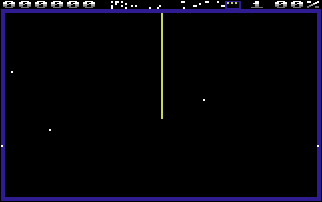
Zolyx

Zolyx: perfect movie fodder! Are you listening, Hollywood? I’ll write the screenplay for 50p and an extra-large bag of wine gums!

May 22, 2008. Read more in: Film, Gaming, News, Opinions, Retro gaming

Comments Off on Pac-Man: the movie

Review: Namco Museum DS

Soon to be gathering dust

Rating: 2/5

Namco hates you. That’s the only conclusion I can reasonably draw from the company’s decision to release Namco Museum DS in its current form. Although not quite as stingy as previous Namco collections for Nintendo hand-helds, you still only get eight games for your dosh, and one of those is The Tower of Druaga. Plus, most of the rest are the usual suspects that get churned out time and time again, including Pac-Man, Xevious and Galaga. Considering the recent Namco Museum: 50th Anniversary Arcade Collection featured well over a dozen titles, DS owners would be right in feeling short-changed.

As is typical of Namco compilations, the ports are pretty good, and the interface is one of the best I’ve seen on a DS-based compilation. The game screen can be rotated, to avoid squish-o-vision, and geeks can muck about with dip switches ad-nauseum. There’s also a surreal and unsettling ‘music box’, where characters from the featured titles dance like maniacs to tunes and sound effects from the compilation’s games.

This collection’s saving grace is undoubtedly Pac-Man VS., a four-player wireless effort that is roughly the videogame equivalent of tag crossed with Pac-Man. Three players become the ghosts, while the fourth controls Pac-Man. If a ghost is successful in grabbing the jaundiced pill-popper, the relevant player assumes that role, and the first person to amass a points target is crowned king of retroville.

Sadly, though, it’s not enough. Namco has a massive back catalogue to draw from, and against the 15-game feast that is Konami Arcade Classics, Namco’s effort feels comparatively pale and shallow, despite the polish and multiplayer Pac-Man shenanigans.

Namco Museum is available now for Nintendo DS for the princely sum of 25 quid. Wait a few months and it’ll inevitably end up in the bargain bins, whereupon it’ll actually be worth the money.

Namco Museum DS

Innovation? Exciting new retro products? You won’t find them here!

May 21, 2008. Read more in: Gaming, Nintendo DS, Rated: 2/5, Retro gaming, Reviews

1 Comment

« older postsnewer posts »