The BBC reports that the EU has decided to extend music copyright to 70 years. However, I feel the article needs some helpful translation work.
Musicians are set [to] receive royalties for their songs well into their old age under a new EU ruling.
“Record labels are set to make even more money from dead and very aged popular musicians, under a new EU ruling, which doesn’t actually help most musicians.”
Regulations approved on Monday extended copyright on sound recordings from 50 to 70 years.
“Cliff Richard’s earliest songs had started to enter the public domain, which would have reduced his royalty cheques by a little bit, and this would have been a disaster for the 250-million-records-sold musician.”
According to those backing the law, the copyright extension is all about creating an ‘incentive for authors’, and I’m sure Cliff and others in their 70s will now feel a huge incentive to make more music and be more creative. We’ll for a moment ignore all the people who could have done something truly creative with popular songs entering the public domain.
The move has been welcomed by the music industry. Presenter Jools Holland called the ruling “fantastic news”. “Artists put their hearts and souls into creating music and it is only fair that they are recompensed in line with the rest of Europe,” said Holland who also performs and records his own music.
“And who is also getting on a bit, which has nothing to do with his stance on this subject.”
I agree with copyright and patenting in principle. There should certainly be a period during which a creator and their backers reap the rewards of creativity. But there must be balance. In extending copyright beyond the point most creators will live, we’re not encouraging creativity; instead, we’re helping a few very old musicians not lose some royalties from their earliest recordings, but mostly filling the pockets of record labels petrified of losing their investment that’s already been paid for myriad times.
Still, I can’t imagine anyone expected a different outcome, and copyright for popular media will continue to be extended periodically. If you ever think the likes of Mickey Mouse will enter the public domain, I’ve a mouse-shaped bridge to sell you.
September 12, 2011. Read more in: Music, News, Opinions
I’m pretty sure some analysts spend their days lobbing darts at a dartboard and then applying whatever number they hit to the current piece of analysis, especially when it comes to marketshare. However, it takes a truly special company to consider outlandish reports conservative. And so it goes with Bloomberg’s report:
Microsoft Corp. (MSFT) said its Windows Phone operating system may capture more than 20 percent of the smartphone market over the next two to three years with the help of hardware manufacturers and increased marketing efforts.
So, here we have an analyst firm—Gartner—who thinks Android will lead forever in smartphones, growing from a 23 to 49 per cent share, and that iOS will struggle onwards, growing its share from 16 to 17 per cent. Windows Phone? Naturally, that will skyrocket from 4.2 per cent to 19.5 per cent, blazing past iOS in the process. And yet Microsoft thinks that’s conservative. Presumably by 2020, every single smartphone will run Windows Phone and will directly jack your brain into Steve Ballmer’s PC.
Perhaps I shouldn’t be too quick to judge. People thought Apple didn’t have a chance, and it took a fair chunk of the market. But then Apple did that by innovating and creating a new type of personal computer/smartphone hybrid that took Apple users and everyone else by storm. I fail to see how Microsoft will have such meteoric marketshare rise, even with its Nokia tie-up, when most people either remain infatuated with the iPhone or happy with the cheaper/more expandable Android alternatives. Still, maybe Microsoft knows something I don’t—perhaps Tim Cook in his new CEO role is hastily remaking all iPhone 5 cases out of fish scales.
September 5, 2011. Read more in: Apple, News, Opinions, Technology
Joanna Stern on the Samsung Series 7 Slate PC:
It literally has the guts of a high-end laptop, including a dual-core Core i5-2467M processor, 4GB of RAM, and a 64 or 128GB SSD.
Oooh. Well, oooh, if you care about specs, which most people don’t these days. So, um TECHIEOOOH.
Yet despite those organs, it is said to have over six hours of battery life.
iPads of course clock in at over six hours, too; in fact, they nearly double that. Still, Apple kit’s a rip-off, so maybe the Samsung tablet will at least be affordable.
The 64GB version, which comes with a stylus
Extra value in a losable pointing stick!
will ring up at $1,099.
Just like the iPad, if you buy an iPad 2 while simultaneously setting fire to $400.
Samsung’s done a very nice job of cramming all those components into a .5-inch and sub two-pound tablet.
Thereby making it only merely nearly twice as heavy as the iPad.
[T]he biggest problem is the software, and while the pen and keyboard make Windows 7 more palatable, finger input remains a huge issue. In my short time with it, I mistakenly poked the minimize window button rather than the maximize and struggled to dig out the Paint program from the Start Menu. Samsung is trying to improve things with its Launcher program, which is basically a series of app homescreens, but that skin doesn’t go very deep. Your best bet here is to keep the pen in hand.
Sounds great. So what’s the verdict?
[T]he Series 7 Slate may be the best Windows 7 tablet ever made
Sounds a bit like someone waggling a smallish stick and saying it’s the best stick you could poke yourself in the eye with. I’m still struggling to get Microsoft’s tactics. It has a great OS in Windows Phone that looks like it would be perfect for tablets, but, no, instead they’re still trying the same ‘normal Windows on a tablet’ thing that’s proven to have failed badly for years now.
Hey, Ballmer: 2001 called and wants its concepts back!
Hat tip: Curious Rat.
September 1, 2011. Read more in: Apple, News, Opinions, Technology
During the spate of articles about Steve Jobs stepping down as Apple CEO, one of the major aspects of his success was put down to an ability to say no. This leaves Apple products with fewer features than those from its rivals, but, typically, superior usability and focus. The blog post Improvements in Windows Explorer rather starkly highlights the opposite approach. It traces the lineage of Microsoft’s file manager, from its hideous beginnings in Windows 1.0 through to the arrival of sanity in Windows XP. But then you get to Windows 8.
Over the years, Explorer has grown to support a number of different scenarios, many unrelated to file management – launching programs, viewing photos, playing videos, and playing music, to name just a few. We wanted to know which of these capabilities customers were really using. Using telemetry data, we were able to answer the question of how the broadest set of customers use Explorer in aggregate. As a reminder, the telemetry data is opt-in, anonymous, and private, but it does represent hundreds of millions of sessions from all customer types.
This data is pretty interesting. First it shows that even though there are over 200 commands in Explorer, customers use a small number of them with any real frequency: the top 10 commands represent 81.8% of total usage. Additionally it shows us that people overwhelmingly use Explorer for core file management tasks – the top 7 commands (72.2% of usage) are all for managing/manipulating files.
Apple’s clearly done similar testing with its applications over the years, in an effort to streamline. Finder has, if anything, simplified during OS X’s evolution. Therefore, it seems someone removed logic from the equation in allowing Microsoft’s Explorer team to do this:
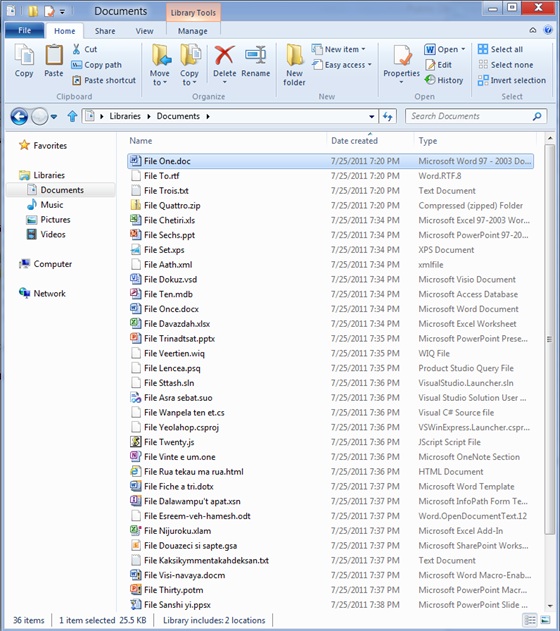
To be fair, the Ribbon can be hidden in Explorer, and that’s just as well, because Microsoft’s created a horrible mess that will intimidate newcomers: instead of concentrating in the “top 10 commends [that] represent 81.8% of total usage”, this new interface flings tons of options in your face. It’s also hard to tally this vision of the future of computing not only with Apple’s iOS but also Microsoft’s own Windows Phone OS, which is currently being smashed into Windows 7 with a hammer, to create the hybrid OS that Steve Ballmer seems to think everyone wants.
Perhaps Microsoft will emerge victorious. Maybe people really do want to run the ‘full’ version of Excel on a tablet device rather than the sleek and simpler Numbers on an iPad. But I’ve a sneaking suspicion the kind of craziness and chaos showcased in the Microsoft blog post rather shows the opposite. It’s complexity for the sake of it, and showcases an inability to say no to including something, ‘just in case’ a few users might need it.
September 1, 2011. Read more in: Apple, Design, News, Opinions, Technology
Fucking hell. That nicely sums up my reaction to AllThingsD’s article stating that Apple’s canned TV rentals. Being British, a mystical place called ‘overseas’ that whoever does Apple’s media deals isn’t entirely sure actually exists and therefore largely ignores, I had to use a sneaky US account to access TV rentals on the Apple TV. And here’s what happened:
- 48 episodes of Lie to Me rented ($47.52)
- 48 episodes of Castle rented ($47.52)
- A bunch of miscellaneous rentals of Grey’s Anatomy and random other shows (about $100)
Without Apple TV rentals, we (Mrs G and I) would have probably never discovered and watched Lie to Me. Grey’s Anatomy… we were acquiring that by ‘other means’ before the 99-cent rentals rendered that pointless. And Castle? Well, we love Castle, but not enough to spend loads of cash on it. We’d have waited for the inevitable DVD firesale in the UK or US and picked it up for bugger all—and certainly than for less of the price of the iTunes rentals.
Apple’s laughable spin is that “customers have shown they overwhelmingly prefer buying TV shows”, but that’s bullshit. While reaction to my complaints about Apple binning TV rentals on Twitter shows this is certainly the case for some people, it isn’t for others; more likely, the studios holding back their content was to blame, leaving the rental selection in a pitiful state, especially towards the end. And at the same time the likes of Warner Bros. were arguing 99-cent rentals devalued their content, they were of course allowing Netflix users to download as much as they liked for eight bucks per month. Classy.
So, where does this leave anyone who loves TV? Well, you now have the following choices:
- Pay for hugely expensive cable or satellite, which gives you tons of crap and a few shows you actually care about.
- Pay over the odds for shows on iTunes: £2.49 ($4) per HD episode, in the UK.
- Grab waste-of-resources Blu-rays or DVDs when they show up or, if you’re savvy, hang on for the sales, and then try to figure out how to fit your ever-growing collection in your home.
- Visit the naughty web and say “screw you” to the studios.
Me, I’ll probably head for the third of those options now, but I’m sorely tempted by the fourth. The thing is, I actually want to pay for good shows and support those who make them, but the studios aren’t making it easy. I’m not paying twice as much for a series of House on iTunes as it costs on DVD, but I’m also not exactly thrilled by the prospect of buying more discs-in-card-boxes that waste resources and take up space. I also don’t really care to download content that I then ‘own’ and that takes up hard drive space when I only watch the vast majority of shows once. (Note to US readers yelling “But what about iCloud?”, Brits will only get app and book sync initially—we’re left out of the media-streaming excitement.)
So, yeah, thanks, Apple and thanks, greedy studios. Maybe one day the studios will wake up and realise that 99p or so would be a sensible price-point for a TV show, but I won’t hold my breath. (Even many games companies don’t seem to understand that popular products sell way more copies when they’re cheap, otherwise Pac-Man would always be 69p, rather than rather more ambitiously priced.) Also, take this surrender by Apple as a possible shot across the bows regarding digital movie rentals. As I said a couple of weeks back, they’re now being removed from iTunes with alarming speed, to drive up purchases that are often costlier than grabbing a DVD. It wouldn’t shock me if Apple quietly decides to trash that aspect of the iTunes Store, while being strong-armed by the studios, under the excuse that people want to ‘own’ their movies.
August 26, 2011. Read more in: Apple, News, Opinions, Technology, Television