Apple’s first CEO, Michael Scott, on tech success

Business Insider has a great interview with Apple’s first CEO, which offers this gem:

[W]hen IBM decided to get into the PC market they chop-shopped out the hardware to several different groups so you had a mess of hardware, and they’ve been trying to cobble the software on it ever since.

And you still see that in the phones and the iPad or the computers. You have to control both, or you end up with a mess. Android is a good example now, as Google’s learning, if you don’t have a level of discipline, you end up ruining the product.

For all the people complaining about Google increasingly locking things down, that will probably benefit the platform in the long run, because it will be able to control more of the experience. Whether Google has the design and UX know-how to really compete with Apple in this area (and its online apps suggest it doesn’t) remains to be seen. I’ll bet Amazon does though.

May 25, 2011. Read more in: Apple, Opinions, Technology

Comments Off on Apple’s first CEO, Michael Scott, on tech success

A quickfire review of the iCade games controller for the iPad

Touch Arcade just reviewed the iCade, and made a bunch of points I agree with, but some that I vehemently disagree with, notably

I found tearing through these classic games [in Atari’s Greatest Hits] on the iCade to be everything I’d hoped it to be. On the whole, it’s just an awesome experience

and

As far as I’m concerned, the iCade (along with Atari’s Greatest Hits) is an absolute must-have iPad accessory for the serious retro gamer.

But I’m getting ahead of myself, so QUICKFIRE HISTORY MODE!

In April 2010, wags at ThinkGeek announced the iCade, but, alas, it was April 1, stupid face! Duh! But heros in the distance emerged in the shape of ION Audio, who went “man, that’s a great idea”, licensed the design and made it a real boy.

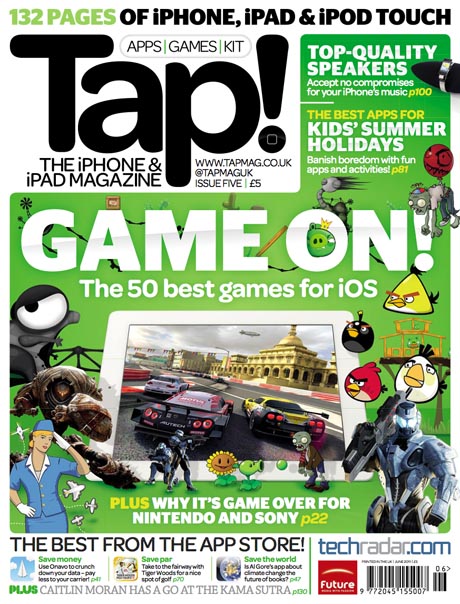
I got to play with an iCade while working on issue 5 of Tap! magazine, and my review unit came pre-assembled, so I’ll have to take Touch Arcade’s word for how easy it is to put together. Touch Arcade’s bang-on about the unit itself, though:

  • The iCade feels weighty and robust. It feels like it could stand up to a lot of fairly heavy gaming.
  • The buttons have a great feel to them, and click in a very satisfying manner.
  • The stick’s travel is too long (and my unit’s one ‘stuck’ in the left position quite a lot), but is nonetheless reminiscent of arcade sticks of old. (I always used to play games with a Competition Pro, which had a lower travel and was therefore more responsive.)
  • The iPad sits very nicely within the unit in portrait mode, although you need to watch the surprisingly heavy lid doesn’t snap down on a finger, like it did on mine. (Ouch.)
  • In landscape mode, the iPad perches a little precariously in a small ridge.
  • Set-up/pairing with the iPad was reasonably simple, although in my case it took a few attempts.

The problem I have with the iCade as it currently stands is the games—well, app (singular) Currently, iCade only works with Atari’s Greatest Hits, which is a compilation I’d call middling if I was being charitable. The compilation includes a bunch of Atari 2600 games, which aren’t emulated correctly and only play in portrait (wasting loads of screen space), along with a selection of arcade hits, most of which were specifically designed by Atari to have unique control systems. You can see where this is going, can’t you?

In use, the iCade itself is actually pretty good, but the experience of the only compatible piece of software is not. Atari helpfully leave some of the interface behind, so you get to watch a giant pause button along with your game, but it helpfully removes the gigantic virtual joystick, leaving a huge blank space under the game. Had Atari enabled landscape mode for Atari 2600 games, I might have overlooked the shortcomings in emulation (major colour problems in some games, poorly emulated sound), but the entire thing felt more proof-of-concept than “an absolute must-have iPad accessory for the serious retro gamer”.

With arcade games, things weren’t much better. The games felt a bit like home conversions rather than the arcade originals: Tempest and Crystal Castles stripped of their spinner and trackball, respectively, and lumbered with joystick controls aren’t as satisfying nor as playable. However, ironically, because Atari’s Greatest Hits is so bad on the iPad, scaling up the iPhone mode’s virtual controls (meaning in Tempest that you need GIANT THUMBS to reach the superzapper button), iCade does actually make for a better experience—but that doesn’t mean it’s a good one. And again there’s the interface issue, with some games barely filling half the screen and many showing redundant controls.

Given that the iCade will cost 75 quid in the UK (it’s $99 in the US), I think you’d be bonkers to consider it, purely because of the lack of software. But if ION can get a lot of developers on board, and those developers actually take enough care when adding iCade support (minimum: full-screen games), the device would be a very different prospect. I know Manomio (the C64 emulator guys) are already working on support, and I sincerely hope others follow suit, including Taito, Namco and especially Capcom. Street Fighter games on iPad with the iCade would be fantastic, as would Namco’s Pac-Man: Championship Edition. But that’s currently a big ‘if’. For now, then, my opinion of the iCade is subtly different to what Touch Arcade wrote, but it’s an important difference: iCade could become an absolute must-have iPad accessory for the serious retro gamer—but it’s not there yet.

May 25, 2011. Read more in: Apple, iOS gaming, Reviews

Comments Off on A quickfire review of the iCade games controller for the iPad

Before there were Apple Stores

Ted Landau offers an article from a US perspective on what it was like before there were Apple Stores:

[Y]our first problem would be finding a retail store that sold Macs. Apple’s fortunes had fallen so low that most people assumed the company would be bankrupt before the millennium arrived. Even the arrival of the iMac in 1998 did not do much to reverse that belief. As such, many retail chains treated Apple products as if the sales staff could get leprosy by touching them.

I can recall my own dismal experience. I walked into the store and was immediately greeted by a dizzying array of computers and peripherals. Only one problem. Everything was Windows-related. Not one Mac or any other Apple product was visible. When I asked a salesperson about Macs, I was directed to the rear corner of the store — back near where they kept empty cartons and other related trash. Here I found a few Macs (never the complete line of products) sitting around in a disordered and unappealing display.

As for the […] salespeople, they varied from Mac-ignorant to Mac-hostile, often both. On several occasions, when I asked a question, the salesperson pretended to know what he was talking about and confidently gave me the entirely wrong answer. Not surprisingly, these same sleazeballs typically tried to steer me away from Macs altogether, suggesting that Apple was only for losers. “If I went with Windows, I could get a better machine, with more third-party software, for less money.”

All this was true in the UK, too, only here you’d pay roughly twice what Americans got charged for the same hardware. I remember the odd PC World selling Macs, but they were inevitably turned off, and customers were hurried away from them by sales staff who said you “can’t run Word on a Mac” and that “Macs might well come to life at night and eat your first-born,” or some other bollocks.

Today, things are much brighter, and I put much of Apple’s resurgence down to these stores. It’s one thing to think you might like a product, but I’ll bet Apple today sells far more kit through people experiencing it first-hand—even if only for a few minutes in one of its stores—than it would if it had it remained an online-only operation. Additionally, it’s clear Apple’s high-street success has increased support elsewhere, too. In the UK, there are more resellers of Macs than I’ve ever known, even including the likes of Argos.

I’ll also add one further comment: on experiencing Apple Stores of all sizes, from the gargantuan and beautiful Covent Garden store, to smaller efforts in the likes of Southampton and Tampa, one thought often crosses my mind: why aren’t more stores this well designed, laid out and accessible?

May 24, 2011. Read more in: Apple, Opinions, Technology

6 Comments

Android’s openness only extends as far as it benefits Google

A great piece from Ars Technica’s Chris Foresman on openness advocates Google now blocking rooted Android devices from its new movie-rental service. You know, those devices people rooted to remove all the crap carriers bundle, to ‘add value’, which is a benefit of Android being ‘open’?

But it serves as yet another example that Android’s openness only extends as far as it benefits Google.

I’m wondering when people will get the hint about this. Everyone whinges about Apple’s walled garden, but it’s pretty clear Google just has a different kind of wall, and one it’s sneakily putting up a brick at a time, hoping no-one’s watching. There is one big difference with Apple, though, as Harry Marks says:

Where’s the outrage? Where are the riots? Where’s the media sensationalisation?

Where indeed? I guess, for some reason that isn’t entirely clear to me, while Apple blocking jailbroken iOS devices from iBooks is evil, Google blocking rooted Android devices from movie rentals is a-OK.

May 24, 2011. Read more in: Apple, News, Opinions, Technology

5 Comments

Twitter buys TweetDeck, so now make it consistent… Yeah, right

I’ve been banging on of late about Twitter’s boneheaded thinking regarding developers. Short version: Ryan Sarver, who heads up Twitter’s platform team, tells people to stop making Twitter clients, because:

With more people joining Twitter and accessing the service in multiple ways, a consistent user experience is more crucial than ever.

Twitter then starts making life difficult for devs by screwing around with how logins work, except for in their own clients, obviously, (which Twitter claims are part of the service, so THAT’S ALL RIGHT, THEN).

Reports are now coming in from all over that Twitter has bought TweetDeck (CNet). I personally can’t stand TweetDeck, but I know a lot of people who use it, and if third-party clients were all shot in the head, TweetDeck’s death would cause the biggest uproar. Therefore, it’s going to be extremely interesting to see what Twitter does next.

Conceivably, it could kill TweetDeck, but that makes no sense. Even if the purchase was made defensively, to stop TweetDeck becoming a client for a rival service, too many Twitter users work with TweetDeck to make the app disappear. Twitter could roll the column and multi-account-post functionality into its own clients, perhaps as an ‘advanced’ option, but that doesn’t sit right with the, frankly, bare-bones nature of Twitter’s official clients.

The only sensible course of action is for Twitter to continue allowing TweetDeck to exist, but then that makes a mockery of Sarver’s statement about consistency (although as Steve Lyb has noted, Twitter’s doing perfectly well on its own in that regard). Still, given the ‘one rule for us, and another for everyone else, which largely involves PUNCHING DEVS IN THE FACE UNTIL THEY GET THE HINT AND BUGGER OFF’ mindset Twitter apparently employs these days, that last option wouldn’t surprise me at all.

May 24, 2011. Read more in: News, Opinions, Technology

1 Comment

« older postsnewer posts »