I remember when I was a kid, games magazines would clamour for ‘exclusives’. Every cover would scream EXCLUSIVE REVIEW! at you, and every mag would somehow have the same EXCLUSIVE! coverage of the same EXCLUSIVE! games. It was hugely tiresome.
However, one thing that was apparent with games mags back then is the people behind them often played games for an absurd amount of time before coming to a conclusion about them. But with the shift to the web, the need to be first with reviews is coming pretty close to breaking the entire point of critical coverage.
As a case in point, I happened across a couple of reviews earlier today for two new iOS titles. These games were released last night, and reviews are already online, rating the games and providing buying information for the website’s readers. On reading the reviews, it’s horribly clear that neither game was properly tested, because there are inaccuracies throughout. There’s little point in naming the site, because it’s hardly unique in doing this kind of thing, and with readers demanding to know RIGHT THIS SECOND whether or not something’s any good, it’s hard to blame the editors.
It would be good to see sites have the balls to try a different approach, and only review games when they’re ready to be reviewed. This is what I do with iPhoneTiny. Even though the reviews are only 140 characters long, I aim to only review a game or app when I really know what I think about it. This is why some reviews are turned around a few days after a product’s release but others take weeks. Online, this could be a differentiator, and in print it’s ridiculous to not take this line—after all, any EXCLUSIVE! review within a mag’s pages has already been ‘outexclusived’ by myriad websites.
August 26, 2010. Read more in: Magazines, Opinions
Samsung’s decided the best way to get one over the iPad is to go all sci-fi. “Create a clone,” said the directors. “The iPad will be caught unawares. Then, when it least expects, we can kick it repeatedly in the knackers until it begs for mercy—but we don’t have any of that. MWAHAHAHAHA!”
OK, so that’s perhaps a bit far-fetched. It’s probably more likely that some higher-up at Samsung got an iPad, went “oooh, shiny”, shoved it in front of the company’s design team and said: “One of those please, but in Android flavour”.
And if you think I’m exaggerating, take a look at Matt Gemmell’s Samsung Galaxy Tab comparison with iOS. Mid-1990s Microsoft has nothing on these guys.
August 25, 2010. Read more in: Apple, Design, News, Opinions, Technology
The Wall Street Journal reports on LG’s vice president of marketing saying LG is readying an iPad ‘killer’. Again, the claims are pretty much copied and pasted from the How To Get Tech Journos Excited About Your iPad Killer That Doesn’t Actually Exist fact sheet: Android device; better than iPad for [SUB: INSERT REASONS HERE]; “our device will totally rock”.
What’s most surprising, though, is Chang Ma’s slightly odd decision to smack the iPad with the same kind of bullshit that lazy tech journos use. Ma is quoted as saying the iPad is a great device, but that he doesn’t do much work on it, inferring that Apple’s device is for displaying content, not creating it:
[LG’s] tablet will include content focused on creation such as writing documents, editing video and creating programs. It will also have “high-end features and new benefits,” many of which will focus on productivity, Mr. Ma said. “It’s going to be surprisingly productive,” he said.
Man, if only the iPad had some kind of App Store, with hundreds of great apps for boosting productivity and creating work, such as SketchBook Pro, OmniFocus for iPad, Pages and Numbers, Bento for iPad, iMockups for iPad, OmniGraffle, Markup for iPad, and ReelDirector, we wouldn’t be stuck waiting for LG to magic a ‘productive’ tablet into existence, along with the dozens of unicorn-dust-sprinkled apps that will also suddenly be available to make said tablet productive.
August 24, 2010. Read more in: Apple, Design, News, Opinions
If you’ve not read it yet, go and check out Marco Arment’s A smartphone retrospective. His post from last week shows a bunch of 2007 smartphones, noting that they were cool but flawed, then says the iPhone happened. Despite all the protests about the iPhone’s lack of hardware keyboard, removable battery and expansion, pretty much all rival kit now apes Apple’s. Arment ends by showcasing a number of early 2010 netbooks, then says the iPad happened, and asks where the inexpensive computer space will be in a year.
Well, we’ve already seen various rumours and renders, and now, if Notebookitalia is to be believed, Toshiba’s about to enter the fray. There is, however, another aspect to the hardware shifts that Arment didn’t mention: the specs pissing contest. Most of Apple’s rivals aim to beat it in terms of specs rather than usability. They generally don’t aim for something that’s better for the general user, instead churning out hardware that offers more ‘stuff’.
If this really is to be Toshiba’s iPad ‘killer’, it’s certainly true to form. It’ll supposedly run Android (tick), look a bit like it was designed by Apple on an off day (tick), have more hardware buttons than really necessary (tick), and include a ton of ports, including USB and HDMI (tick). Judging by the images on Notebookitalia, this comes at a big price: form factor. It’s clear if this device makes it to market that it’ll be thicker than the iPad, but the edge with the ports also appears much thicker than its opposite side. This means Toshiba’s pad will have a natural landscape-only orientation, and will be horribly awkward in portrait mode. By contrast, the iPad generally doesn’t care which way up it is and apps encourage the user to turn the device to find a set-up that best suits them.
Still, if Toshiba’s model is released, I’m sure tech journos will claim it’s an iPad killer, because, once again, they’ll read the spec sheet, get terribly excited about things most users don’t care about, and forget that people—normal people—just want to get on and do stuff. Apple’s industrial design and usability will again be dismissed as gloss, right up until the moment its rivals catch up, whereupon those things will somehow become both exciting and essential.
August 24, 2010. Read more in: Apple, Design, News, Opinions
Namco’s iOS games have been underwhelming, with little imagination and a tendency to trot out the same old properties they’ve been reselling since the days of the GBA (at least). That said, Pac-Man games work nicely on iOS: on the iPhone, Pac-Man, Ms. Pac-Man and Pac-Man: Championship Edition are all great games, if often rather ambitiously priced.
On the iPad, Pac-Man was, disappointingly, an upscaled version of the iPhone game (no universal updates in Namcoland!), with nothing added—until now.
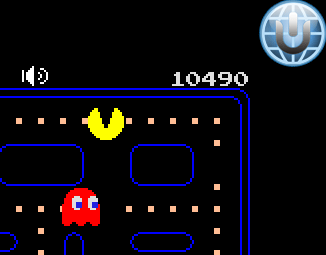
Observant readers will notice that there’s a less-than-subtle ‘thing’ on the screen grab above, which certainly isn’t part of the original Pac-Man arcade game. Namco calls this ‘Pac-Man for iPad [being] equipped with Namco’s online community powered by UniteSDK’. I call it something rather different: a hideous monstrosity.
Whatever compelled Namco to ruin its pixel-perfect Pac-Man port for iPad with this nasty button that you cannot remove, I’ll never know. It’s ugly, and it’s a distraction; worse, it’s totally unnecessary. Did someone at Namco really think: “You know what? When I’m mid-game, fleeing Blinky, Pinky, Inky and Clyde, the one thing I really need to do is tap on a social network icon, just to check on my ‘achievements’ and messages”?
This now-aesthetically-ruined game now merely serves as a lesson to other iOS developers: by all means integrate gaming social networks into your games, but don’t have them ruin things with permanently on-screen graphics or irritating notifications.
August 23, 2010. Read more in: Gaming, iOS gaming, Opinions