Click! Click! ARGH!
I’m a tad late in mentioning it, but I was again fortunate this month to pen .net’s cover feature, which this time was about site navigation.
As is often the case, it’s inevitable that personal opinion creeps in to these things, even if I’m not quoted myself. Through the words of others, my own preferences were pretty evident in the piece: a love for intuitive, simple, carefully labeled and consistent navigation. Perhaps surprisingly, this didn’t mean saying nasty things about Flash, and although I bit my tongue a couple of times, Adobe’s ubiquitous technology got a good showing and not a hammering.
What was hard, though, was deciding on the best-in-show sites: ten examples of top-notch navigation, each of which happened to be different enough from the others to warrant inclusion. These days, I’m pretty easily annoyed by websites, and many have absolutely ghastly navigation in so many ways.
Overall, I’m pretty happy with the sites I chose, which included Guardian, Adobe, Wieden+Kennedy, Apple and the BBC. It’s notable, though, that even in these leading sites, there are major problems: the BBC’s effort to make mainstream user-personalisation of the navigation experience is hampered by dreadful bulky design conventions; and Apple’s no-nonsense approach is gradually being eroded by things like utterly hateful ‘activate on hover’ Ajax drawers.
Truly, no-one gets things perfect, but the general tendency now appears to be towards inconsistency and being too clever for your own good. After recent years of simplification and honing down, and with devices like iPhone showing how simple and efficient navigation can be, that’s a worrying trend to see.

Are they trying to suggest we’re all talking a load of hot air? WE DEMAND THE TRUTH!
June 5, 2008. Read more in: .net, Magazines, Opinions, Web design
A couple of weeks back, Retro Gamer 51 escaped from its confines (somewhere in Bournemouth), to be unleashed on the world. Inexcusably, I totally forgot to get the pimp-o-pointer out, hence this belated post.
This month, the magazine has one of those shiny gold covers, which collect fingerprints and blind small pets unlucky enough to glimpse the magazine in bright sunlight. The cover has a big Zelda image, but the game I wrote about didn’t make the cover this time, nor even the contents page. Instead, tucked away on page 84, you’ll be pleasantly surprised to find The Making of Choplifter. Well, you would have been pleasantly surprised if you’d not read this blog post, obv.
Choplifter not getting on to the contents page didn’t irk, but it did throw up the question: what is a classic game that will grab readers? Dun Durach and Heroquest both made it on to the contents page this month, for example. What it confirmed to me is that classic games really are in the eye of the beholder (and also the editor), and that those titles you think are most loved and well remembered may not be. Still, I was happy to interview Danny Gorlin and spend a few hours testing out the surprisingly large number of Choplifter conversions. Well, apart from the Sega ones, which are horrible.

Sarah Beeny realised this episode of Property Ladder was going to be hairier than usual.
June 2, 2008. Read more in: Apple II, Retro Gamer, Retro gaming
The crime is life. The sentence is dentistry

When Judge Death first appeared, he was terrifying. A twisted marionette-like figure with an evil, decaying grin, dressed in a mockery of a Mega-City One Judge’s uniform, the grotesque creature sent chills down young spines. Kids were fascinated by the mystery. What was this creature? Where was he from? We were only offered tantalising glimpses, echoes about Death having wiped the stain of life from his world, where life itself was considered a crime.
Subsequent years saw more of the pieces fall into place, but as the gaps in Judge Death’s backstory were gradually filled, I liked the character a little less each time. He no longer held such mystery, and because the usually dependable John Wagner bizarrely warped the fiend into a tiresome comedy character, he no longer held any allure.
This collection is a long way from Judge Death’s nadir, but it’s no classic either. In a tale that originally saw print at the very beginning of the Judge Dredd Megazine, during the early 1990s, Judge Death holds hostage a Mega-City One reporter, forcing him to write Death’s history. This largely revolves around a cruel younger version of Judge Death (named Sidney) being inspired by his brutal dentist father into becoming a full-on genocidal maniac, ably aided by a little black magic and some college friends.
Ultimately, insight like this wasn’t really needed, and Young Death veers a little too far towards the comic side of black comedy. And although the story is fine—in fact, it’s quite enjoyable in itself—and well illustrated by the dependable Peter Doherty (despite his take on the Judge uniforms of Sidney’s world oddly bearing little relation to Judge Death’s own garb), it’s ultimately an irreverent and somewhat expendable tale that sits uneasily between the superior original Judge Death stories and the return to the character’s horror origins in My Name is Death.
Judge Death: Young Death is available now for £10.99. For more information about 2000 AD graphic novels, check out the 2000 AD Books website.

Unfortunately, Judge Death’s radiant smile was augmented by the stench of rotting corpse.
June 2, 2008. Read more in: Graphic novels, Rated: 3/5, Reviews
It’s a dog’s life

Perhaps due to it helming short-lived sci-fi title Starlord in the late 1970s, Strontium Dog always felt like it could happily take the leading role in 2000 AD if Judge Dredd ever nipped off for a quick holiday. Following the exploits of mutant bounty hunters, most notably Johnny Alpha, it was a remarkably fully-formed story right from the off, and is a piece of politically laced science fiction with a smidgen of Western that seems to modern sensibilities to marry X-Men, Firefly and typically British 2000 AD grit.
Rebellion’s Strontium Dog line has been nothing short of astonishing—a remarkably complete collection, charting the strip from its earliest days, even unearthing the most obscure related content (including strange text pages from long-forgotten 2000 AD annuals). With the suitably named Final Solution, the story reaches its end.
To talk in any depth about the epic tale would give too much away, but the general premise has a corrupt British government using a combination of magic and technology to deal with the ‘mutant menace’, teleporting mutants to a deadly dimension under the guise of sending them to utopia. As Alpha and his allies uncover the truth, they have to do all in their power to stop mutants being wiped out once and for all.
Although the original Strontium Dog artist Carlos Ezquerra was absent from this tale, his role was ably taken by Simon Harrison and Colin MacNeil, although the shift from one artist to another mid-story is jarring, due to their different styles. However, Harrison’s dynamic energy works well in the early part of the story, as does MacNeil’s more considered painterly approach during the tragic ending.
Not to be outdone by its forerunners, the book also dutifully packs in a bunch of extras that weren’t squeezed into previous trades, including morality tale The Town that Died of Shame, and the fun Judge Dredd crossover Top Dog, along with the usual selection of covers. And while this collection doesn’t quite hit the dizzy heights of the previous two books in the series, it still comes highly recommended to fans of Strontium Dog and damn good comic-books alike.
Strontium Dog: The Final Solution is available now for £13.99, as are the previous four volumes, all of which are essential reading. For more information about 2000 AD graphic novels, check out the 2000 AD Books website.
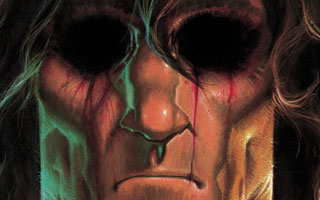
Johnny Alpha does his level best to prompt religious madness by bleeding from where his eyes should be.
May 30, 2008. Read more in: Graphic novels, Rated: 4/5, Reviews
A chip off the old Prog

Henry Flint is, without doubt, one of the finest artists in 2000 AD’s current roster, and has provided exciting takes on Nemesis the Warlock, Judge Dredd and A.B.C. Warriors. Judge Dredd is, again without doubt, one of the finest comic-book characters the world has ever seen. Why, then, does this collection not excite?
Primarily, the problem is that this book feels like a selection of leftovers. Although there are a couple of prime cuts (Turkey Shoot, following the adventures of genetically modified turkeys, trying to escape death at Christmas in Mega-City One, is one of the finest Dredd one-offs of recent years), most of the choices are less than inspired. There’s a mediocre Ocean’s 13 parody, a Robbie Morrison-scripted effort that doddles along until it hits one of the most wrong Dredd panels to have appeared since the strip’s very gestation (showing that Morrison clearly didn’t have a handle on the character), and a few other throwaway tales.
Some substance appears at the very end, in the form of The Gingerbread Man, a gritty murder mystery that involves P.J. Maybe, although this would have been better included in a second volume about the illiterate psychopath. At any rate, it’s too little too late.
This selection was undoubtedly restricted by Flint’s most important Dredd work having already been published in the Aliens crossover and Total War, but it serves as a warning that even a Judge Dredd book by one of the best artists in British comics is only as good as its storylines, and those in this collection rarely rise above average.
Judge Dredd: The Henry Flint Collection is available now for the princely sum of £12.99. Alternatively, grab the far superior Flint-illustrated Total War for a pound less and spend the change on sweets. For more information about 2000 AD graphic novels, check out the 2000 AD Books website.

Judge Dredd punches a punk in the head. Clearly, he’s more of a Miles Davis fan.
May 27, 2008. Read more in: Graphic novels, Rated: 2/5, Reviews