Pac-Man: the movie

Seriously. No, really.

Truth is not only stranger than fiction, but considerably more messed up and generally f——ed in the head. News has begun circulating that Crystal Sky Pictures has signed a whopping $200 million deal that covers five movies, including videogame adaptations. One of the adaptations: Castlevania. The other: Pac-Man. Seriously. Check your calendar, because I’m pretty certain April the 1st was a good few weeks back.

I only hope Hollywood’s take on Namco’s classic about hallucinogenic drugs, repetitive maze-like urban environments, fruit, incessant noise and street crime (OK, I’m struggling here) matches Scott Gairdner’s effort. (“It looks like the hunters… became the hunted!”) And if Crystal Sky Pictures runs out of universally well-known titles, it could always trawl though the thousands of more obscure games on World of Spectrum and Gamebase 64. If any Hollywood execs are reading, I want first dibs on the Zolyx screenplay, OK?
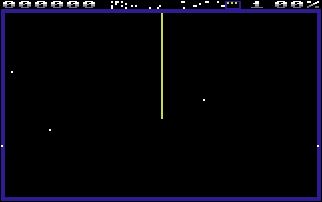
Zolyx

Zolyx: perfect movie fodder! Are you listening, Hollywood? I’ll write the screenplay for 50p and an extra-large bag of wine gums!

May 22, 2008. Read more in: Film, Gaming, News, Opinions, Retro gaming

Comments Off on Pac-Man: the movie

Review: Sláine: The King

Ba ba ba Barbarian

Rating: 3/5

This third volume of Sláine collects the last run of the character’s black and white stories, before Simon Bisley’s painted Horned God artwork forever changed how people saw the grumpy Celtic warrior and his world.

Three decidedly different tales lurk within, and the first might be a jolt to newcomers, with it showing Sláine embroiled in defeating sinister Lovecraftian entities, aided by a ‘leyser’ sword and a motley crew of cannon fodder. With it directly following on from a story in the previous Sláine volume, it begins with a bang, but the tale is extremely episodic, at odds with much of Pat Mills’ more arc-based work on the character.

For me, the high point of the volume is undoubtedly the rarely collected Spoils of Annwn, which returns Sláine to his roots within Celtic mythology. Here, Sláine must prove himself a worthy leader by undertaking a number of bizarre trials, based around the Glastonbury Zodiac, a massive celestial construction carved into the very landscape. The combination of myth, action and sheer imagination makes this one of the best Sláine stories to date, although the artwork is hampered by inconsistent reproduction.

The final act in the book is The King, chronicling Sláine’s return to his tribe after years as a wanderer, only to find his people under the rule of tyrannical demons. At the time, the story was a revelation, with Glenn Fabry’s art rightly celebrated as some of the best to ever appear in British comics. Now, The King almost feels like a bridge between previous Sláine stories and The Horned God epic, as, to some extent, does this book as a whole. But while this collection isn’t a patch on The Horned God or Warrior’s Dawn, it’s still well above the ‘collector’s only’ quality Sláine dipped to during the 1990s.

Sláine: The King is available from all good bookstores (and, presumably, bad ones, too) for £11.99. For more information about 2000 AD graphic novels, check out the 2000 AD Books website.

Sláine: the King cover

Sláine got angry when Wella discontinued its Spiky Hair range.

May 22, 2008. Read more in: Graphic novels, Rated: 3/5, Reviews

Comments Off on Review: Sláine: The King

Review: Namco Museum DS

Soon to be gathering dust

Rating: 2/5

Namco hates you. That’s the only conclusion I can reasonably draw from the company’s decision to release Namco Museum DS in its current form. Although not quite as stingy as previous Namco collections for Nintendo hand-helds, you still only get eight games for your dosh, and one of those is The Tower of Druaga. Plus, most of the rest are the usual suspects that get churned out time and time again, including Pac-Man, Xevious and Galaga. Considering the recent Namco Museum: 50th Anniversary Arcade Collection featured well over a dozen titles, DS owners would be right in feeling short-changed.

As is typical of Namco compilations, the ports are pretty good, and the interface is one of the best I’ve seen on a DS-based compilation. The game screen can be rotated, to avoid squish-o-vision, and geeks can muck about with dip switches ad-nauseum. There’s also a surreal and unsettling ‘music box’, where characters from the featured titles dance like maniacs to tunes and sound effects from the compilation’s games.

This collection’s saving grace is undoubtedly Pac-Man VS., a four-player wireless effort that is roughly the videogame equivalent of tag crossed with Pac-Man. Three players become the ghosts, while the fourth controls Pac-Man. If a ghost is successful in grabbing the jaundiced pill-popper, the relevant player assumes that role, and the first person to amass a points target is crowned king of retroville.

Sadly, though, it’s not enough. Namco has a massive back catalogue to draw from, and against the 15-game feast that is Konami Arcade Classics, Namco’s effort feels comparatively pale and shallow, despite the polish and multiplayer Pac-Man shenanigans.

Namco Museum is available now for Nintendo DS for the princely sum of 25 quid. Wait a few months and it’ll inevitably end up in the bargain bins, whereupon it’ll actually be worth the money.

Namco Museum DS

Innovation? Exciting new retro products? You won’t find them here!

May 21, 2008. Read more in: Gaming, Nintendo DS, Rated: 2/5, Retro gaming, Reviews

1 Comment

From the archives: Why the new iMac sucks

Another one from the archives, and perhaps my favourite: Why the new iMac sucks. This was published on the original version of Revert to Saved, way back in February 2002 (the ‘iMac’ in the article refers to the desk-lamp model), and met with an interesting response, almost taking down my web-hosting account, due to the number of hits it got.

The context of the piece was that, at the time, anything Apple did got slammed by lazy journalists, so I thought it would be fun to satirise this. Unfortunately, a rather large group of Mac users didn’t really understand the concept of satire.

While I’m well aware that Mac users can be sensitive, even I wasn’t expecting the deluge of email I got, including the prize gem “you are a biased computer nerd who cannot accept that most people don’t give a s—— about all the lame insider c—— that you talked about when you reviewed the imac [sic]” and helpfully finishing off with the wonderfully friendly line “you are an idiot and it makes me laugh”.

So, here’s the original article in all its glory—see if you can spot other things I got flamed for. This time, of course, no-one has any excuse for missing that this is satire, although I’ll bet I get at least one angry message from a militant Mac user who reads half the title and furiously fires off an email to me via their new USB-port-challenged MacBook Air.

A totally informed and unbiased account from our leading technical expert, Phil Clive Lover. ©ZealotDumbassNet.com

I watched the MacExpo webcast (and even bore the sickening player that is QuickTime—why Apple can’t use the excellent Windows Media Player like the rest of us is beyond me). I saw Steve Jobs strut around the stage like an over-excited chicken in his ‘oh so cool’ black sweater that made me want to vomit—twice. But then I cheered up, because he announced the ‘new iMac’ and I saw that Apple—so long a thorn in the side of proper PC users everywhere—is finally doomed.

Continue reading this post…

May 16, 2008. Read more in: Apple, From the archives, Humour, Revert to Saved, Technology

Comments Off on From the archives: Why the new iMac sucks

When friends reunited elsewhere

Or: When a business’s driver awakes after being asleep at the wheel

It must be pretty harsh when you find out that you’re totally irrelevant, not least when this is down to being superseded by something about a billion times better. I guess that’s how it feels to be Friends Reunited, who last night sent me some exciting news—their words, not mine.

Now, spam usually puts me in a bad mood, so “this news had better be truly exciting,” I thought. Otherwise, I’d have to say something sarcastic about it on my blog, obviously. So, what was this news, which was, as you’ll recall, exciting? It was this: Friends Reunited is now free (and, apparently, “much more sociable”, although I don’t recall the organisation being particularly aloof before).

Now, if I were a big ol’ dumb-head, I’d be thinking that Friends Reunited was being wonderful, and enabling people to get in touch for free, rekindling old friendships (and, presumably, reigniting old feuds). The thing is, I, like pretty much everyone else I know, abandoned Friends Reunited long ago, leaping over to Facebook, which just happens to have been free from the start and, wisely, has stayed that way.

It’s sad to see a supposedly older, wiser company in the field somehow miss the boat so spectacularly, and Friends Reunited’s latest attempt to not only stop the ship from sinking, but also prevent it from bursting into flames on the way down, smacks of desperation. It’s like when Netscape finally twigged about two years too late that, in the face of massive competition from Internet Explorer, it might be a good idea to stop charging for Navigator, what with a superior and free equivalent being available.

Still, it’s good to see that the money made during Friends Reunited’s time as a paid-for site hasn’t gone to waste. The new Friends Reunited tour is narrated by Martin Clunes. This alone should, clearly, be enough to make the entire world ditch Facebook immediately.

Facebook: less hateful once you’ve blocked all the applications.

May 9, 2008. Read more in: News, Opinions, Technology

Comments Off on When friends reunited elsewhere

« older postsnewer posts »