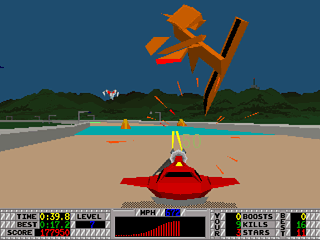
Edge magazine ignores iPod gaming in ‘innovation’ award

Stuart Dredge’s iPhone Games Bulletin just ran a story on Edge magazine once again placing itself firmly in bizarre-o-land. Despite its constant claims at being at the forefront of gaming, it’s made a bunch of stunning screw-ups over the years, the most obvious perhaps being an off-hand dismissal of WarioWare (which got 7/10, a rating Edge has tried ever since to remove from the history books, both by arguing that the review was written by a poor widdle overworked freelancer, and by running 46-page articles on why Made in Wario—the Japanese name for the game that Edge insists on using over the localised one—is so good).

Gosh, that was a long sentence, wasn’t it? Almost as long as one from Edge. Anyway, anyone who’s been keeping tabs on my work will know that I’ve become a total iPod gaming fan-boy of late. The reason isn’t some insane, misguided love for Apple, but the simple fact that iPod (as in touch, or the iPhone) is the only gaming platform that matters.

Ignoring for a second the problems surrounding the App Store (most of which don’t concern the general public), not least the rush to 59p/99 cents that every publisher seems to be taking part in, the simple fact is that since I got an iPhone, I’ve barely used any other games console. The App Store offers thousands of games, most of which are by independent developers, offering highly individual takes on gaming. Because of the nature of Apple handhelds—touchscreen; accelerometer; no tactile buttons—you can’t easily port stuff over from other platforms, and the best games therefore take direct advantage of the system.

To a great extent, iPod gaming is like a return to the 1980s, but with modern technology. Independent developers can make and sell a game, without pandering to the needs of focus groups. These games are then easily accessible (simply download from the App Store), affordable (even ‘expensive’ iPod games are about six quid) and often innovative. Games like Eliss are genuinely doing something new, and I can’t remember the last time I was so excited about a videogames system.

This is why it’s so galling—so hugely irritating—that Future’s supposedly forward-thinking industry bible has once again got it wrong. In its Edge Award For Interactive Innovation 2009 Shortlist, you’d think at least one iPod game would make the cut. You’d think that the magazine, despite its inexplicably tiny amount of iPod gaming coverage, would notice one of the genuine futures of gaming, and champion it, shouting from the rooftops.

But no. Instead, the publication specifically singles out iPod gaming, stating “the games made for these environments are still nascent” (And why is that a bad thing? I seem to recall arcade games development was once ‘nascent’, but we still hail Defender, Robotron and Missile Command as classics) and “It’s difficult to think of an iPhone game that truly exemplifies the singular abilities of its host”. Really? I can think of at least a dozen, but perhaps this merely shows how Edge is stuck in the past rather than the future, if it’d rather showcase the likes of Far Cry 2—an impressive but incremental update on the FPS genre—over products that genuinely innovate.

Many gaming platforms are suddenly finding themselves becoming increasingly irrelevant as new formats take hold. It seems Edge is going the same way.

August 7, 2009. Read more in: Gaming, iOS gaming, News, Opinions

Comments Off on Edge magazine ignores iPod gaming in ‘innovation’ award
Chuck chucks Missile Command history out the window

While watching the latest Chuck last night (‘Chuck Versus Tom Sawyer’, which, knowing UK TV, aired sometime last year in the USA), Missile Command became a major plot point. Chuck (the show) is harmless fun, but it did highlight a problem in taking history and messing with the truth with merry abandon.

The episode was mostly quite well-written and the revisions not nearly as irksome as, say, Titanic taking First Officer William Murdoch and turning a guy who saved lives into a murderer, but I was nonetheless decidedly uncomfortable at times. The reason? Missile Command is essentially a pacifist game. As ex-Atari guy Greg Rivera mentioned to me in a recent interview: “One of the goals [of the Missile Command team] was to teach the futility of war. No-one ever won Missile Command,” adding that there’s no ‘game over’ in the production, just an ominous ‘THE END’ when all your cities are destroyed. In Chuck, however, Dave Theurer is turned into Atari’s Japanese chief engineer, with terrorist ties.

All shows take liberties with history, and I’m sure no malice was intended by the scriptwriters. But in an increasingly hostile age, it’s a shame to see a fantastic satirical, pacifist statement by a true giant of classic videogames misrepresented in such major fashion. Then again, the concept of a living, breathing, vibrant and bustling Atari HQ in the USA almost makes up for it.

Chuck

Crazed Atari fans try to get back at Chuck’s inaccuracies the only way they can—retro-videogame-style.

July 15, 2009. Read more in: Arcade, Gaming, Retro gaming, Television

2 Comments

The downward spiral of App Store pricing

I run an iPhone reviews website called iPhoneTiny, driven by a Twitter feed, and I also write for various iPhone and Mac publications. This means I see a lot of iPhone apps and games, and regularly cull dozens of the things from my iPhone, to set up the next ‘batch’ of reviews.

The upside is that I’m convinced iPhone is a fantastic platform for all manner of things that people would never have believed just a short while ago. Apps like Bento and Things are great from a productivity standpoint, and myriad excellent games have significantly changed my viewpoint since writing Why iPod touch will never be a major gaming platform for Cult of Mac.

The downside—aside from a continual stream of press releases that direct me to an app’s store page rather than promo codes—is that iPhone has created a consumer group that has absolutely no understanding regarding value for money.

One of the first apps I bought for iPhone was Dropship. The game is essentially an update of Thrust, a 1986 arcade game from Firebird that itself riffed off the wonderful Gravitar coin-op. Dropship improves on the classic 8-bit release with dual-thumb controls, beautiful graphics and downloadable levels. More surprising was the price—I bought the app for £1.19. To put that in perspective, that’s 80p less than Thrust cost on cassette tape for the C64, way back in 1986.

Unlike other people, my problem isn’t so much that App Store titles are so cheap, but the fact buyers don’t seem to understand the sheer value of the items on offer. Recently rummaging around the US store, I found reviews for Power Toppler, a remake of C64 cult classic Nebulus. Like the original, the game is absurdly difficult, but it’s fairly good and worth persevering with, and at £1.19 (or $1.99 on the US store), I’d say that’s pretty good value—especially when you consider that’s roughly a third of the cost of the original Nebulus on Wii Virtual Console. Sadly, a recent review on the App Store stated that the game wasn’t worth two bucks.

iPhone owners need to take a step back and understand what they’re getting. Sure, some games are cheap and simple, but even they can be fantastic value. Witness Flight Control, which cost me just 59p, and yet provided more game time than about half the DS games I’ve bought over the past few years—and for considerably more than 59p. However, when you look at the likes of Frenzic (effectively iPhone’s Tetris, but just £1.79) and Eliss (a beautiful and unique touchscreen puzzler that sells for £1.79, but that would fetch £15+ if a DS version was possible), it’s clear too many iPhone owners are looking a gift horse in the mouth and then gobbing in it.

May 6, 2009. Read more in: Apple, iOS gaming, Opinions, Technology

1 Comment

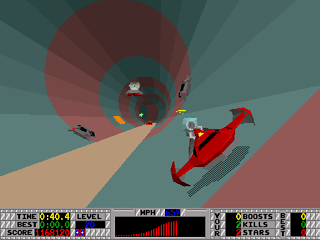
The need for speed: the majesty of S.T.U.N. Runner

S.T.U.N. Runner

Some gaming experiences stay with you forever. I’ve played more videogames than I care to remember, on many different platforms, but I distinctly remember ambling into a very small arcade in Clearwater and, among the beaten-up and half-dead machines, spotting S.T.U.N. Runner.

Akin to smashing a futuristic bobsled game into a rollercoaster experience with a hammer, S.T.U.N. Runner got over the feeling of speed in a way no games had done before and few have done since. The pace was breathtaking to my younger self, and the game over incredibly quickly. But on getting to grips with the game’s mechanics, S.T.U.N. Runner became a fantastic means to while away an hour, escaping from the hot Florida midday sun.

Snapping back to more recent times, Ed Rotberg was kind enough to chat with me last year about his classic tank game Battlezone, and we then talked about S.T.U.N. Runner. Preparing for the interview a day earlier, I fired up the game in MAME and had forgotten how pretty it is. Sleek vector-based designs shoot past at breakneck speed, and even when using a PC, control of the craft is just perfect.

Perhaps this is nostalgia putting the boot in, but I think it’s a massive shame that the game has never been done justice on home formats (with the exception of an astonishing and surprisingly faithful Atari Lynx effort), because even in today’s rush for increasingly extreme gaming experiences, S.T.U.N. Runner still impresses.

My interview with Ed (and co-conspirator Andrew Burgess) is in the current Retro Gamer.

S.T.U.N. Runner

April 8, 2009. Read more in: Arcade, Gaming, Magazines, Retro Gamer, Retro gaming

Comments Off on The need for speed: the majesty of S.T.U.N. Runner

Retro Gamer on NowGamer

Imagine’s answer to EuroGamer, NowGamer, went live recently. With the publisher having a dedicated retro magazine—the rather spiffy Retro Gamer—it should come as no surprise that NowGamer offers a dedicated retro section.

Most of the section appears to be reprint, but there’s some great stuff in there, including a slew of making-of articles, a smattering of company profiles and a couple of ‘def guides’ to videogame series. A fairly random selection of my own articles has been reprinted on the site, including The Making Of: Hitchiker’s Guide To The Galaxy, where I interviewed Steve Meretzky about his collaboration with Douglas Adams.

The game itself remains one of the meanest, toughest and funniest pieces of interactive fiction to date, and with the original article buried away in an old issue of Retro Gamer (and not making the cover nor even the contents pages), it’s great to see it get another airing, not least because Steve Meretzky was a wonderful interviewee. I hope that we can one day talk about the controversial Leather Goddesses of Phobos, which would make for a fun making-of in the mag.

Elsewhere, you can also read my making-ofs on seminal soccer title Sensible Soccer, ubiquitous action puzzler Tetris, US platformer Miner 2049er, fantasy/chess mash-up Archon, and overhead bouncing ball action game Bounder.

As for the magazine itself, Retro Gamer’s on the stands, priced £4.99, and can be bought from retrogamer.net. The current issue includes a making-of Space Invaders, Amiga and Mega Drive retrospectives, and my interview with Ed Rotberg and Andrew Burgess on their classic S.T.U.N. Runner.

April 6, 2009. Read more in: Gaming, Magazines, Retro Gamer, Retro gaming

4 Comments

« older postsnewer posts »