To AV or not to AV—the battle for political reform in the UK

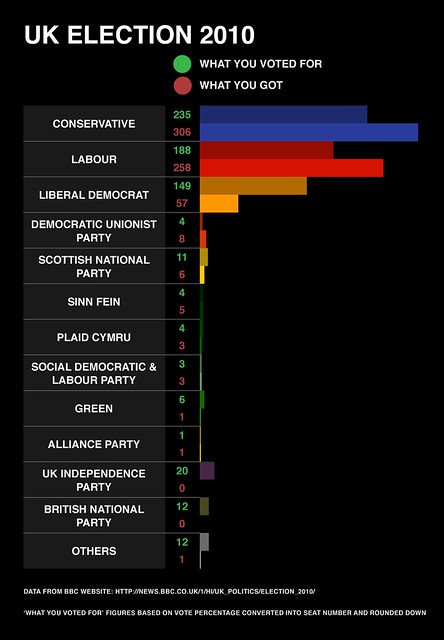
After the 2010 UK general election, I made this:

UK 2010 general election - what you voted for versus what you got

It shows what we voted for and what we got. As you can see, what we got was, as usual, not terribly close to what we voted for. Now, we have a chance for change, but, as usual in the UK, it’s not change anyone wants. We’re going to get the option to replace the awful first past the post system with the barely superior alternative vote.

The BBC sums up the parties’ stances, and it makes for bonkers reading. In summary:

  • The Conservatives want to stick with FPTP, although most Tory MPs don’t think AV would make any major difference to their party.
  • Labour, now finding itself in opposition and with its seeming self-enforced policy of always having to play reactionary politics, is supporting AV. Again, AV won’t make much difference to Labour.
  • The Liberal Democrats are in favour of electoral reform, but really want STV (single transferrable vote), not AV.
  • The SNP is undecided but its leadership says it really wants STV rather than AV.
  • Plaid Cymru supports electoral reform and backs AV, but wants STV.
  • The DUP will back AV, but wants STV.
  • The Green Party will support AV, but wants voters to be able to choose between a range of systems and favours “a fair, inclusive proportional way of voting”.
  • UKIP is backing AV, but wants AV+.
  • The BNP hates AV almost as much as the French and will campaign against, and favours “proportional representation”.
  • The English Democrats, Christian Peoples Alliance, Respect, Jury Team and Communist Party all want a proportional system, and have varying stances on AV.

Reading through that, it’s pretty clear what’s going on and what’s going to happen. FPTP favours those in power, hence the Tories campaigning against AV. AV isn’t a big enough change to make any odds to big parties, hence Labour campaigning for AV, largely to piss off the Tories. For smaller parties, everyone wants a proportional system, so most are backing AV in the hope that it’s a first step towards one.

I’ll bet what’s going to happen, though, is that the Tories, backed by the aggressive and right-wing element of the UK press, will give the AV campaign a serious kicking until the day of the vote. We’ll hear a lot about how poor the coalition has been and how any change to the electoral system could result in more coalitions. (Never mind that the one coalition we’ve had in recent history was, seemingly, supposed to be magical and perfect, yet all the shitty UK governments elected by FPTP haven’t led people to go: “You know what? FPTP is rubbish.”)

Despite this, AV has a chance, because it’ll be backed by almost every non-Conservative party and some major press, and so it might win. But at that stage, we’re done. This won’t be a stepping stone, because Labour at that point will shut up shop. Labour knows that it’d be much harder to win 2015’s election under any form of PR, and so we’d be left with support for further change in the hands of the Liberal Democrats (who almost everyone in the UK now hates) and small parties that are either bonkers (hello, BNP!) or who make sense but have relatively little voice (nationalists, The Greens).

Personally, I’d love to see the UK finally embrace democracy in a very real way and so I’ll be supporting AV, and clinging to the sliver of hope that it’s a stepping stone and not a full stop. It’d be great to show up at the election booth in 2015, knowing that—for the first time in my adult life—my vote actually mattered. I just can’t see it happening though.

February 18, 2011. Read more in: News, Opinions, Politics

1 Comment

Sony clarifies stance on iTunes, backpedals wildly while yelling FORGIVE US

It looks like Sony Computer Entertainment’s Michael Ephraim got smacked by the WHAT WERE YOU THINKING? stick after his recent comments on iTunes. If clicking the previous link’s a bit much effort, he said:

If we do [get mass take up] then does Sony Music need to provide content to iTunes?

Currently we do. We have to provide it to iTunes as that’s the format right now.

Publishers are being held to ransom by Apple and they are looking for other delivery systems, and we are waiting to see what the next three to five years will hold.

Because tech writers are stupid, we all assumed this meant Sony was considering punching iTunes in the face, if Sony somehow managed to not make a total mess of its own digital music offering. (Recent history suggests not betting the farm on that eventuality.)

Business Insider now reports that Sony Network Entertainment COO Brandon Layden has a rather different take:

Sony Music as I understand it has no intention of withdrawing from iTunes, they’re one of our biggest partners in the digital domain. I think those words were either taken out of context or the person who spoke them was unclear on the circumstances.

*sniff sniff* Hmm. Smells of backtrack.

February 17, 2011. Read more in: Apple, Music, News, Opinions, Technology

Comments Off on Sony clarifies stance on iTunes, backpedals wildly while yelling FORGIVE US

Apple versus Amazon

As reported on THE INTERNET, Apple is locking down in-app purchases for content-based apps. In a nutshell, developers will have to enable purchases available elsewhere in the app as well, and for the same price. This means Apple gets a cut, and the content provider loses 30 per cent. Apple argues this rule has existed since the start of iOS IAPs, but it’s just not been implemented for apps like Kindle and Spotify, and claims it’s not out to ‘kill’ such products.

Peter Steinberger on why Apple’s not being entirely truthful about its plans:

Setting up IAP is a pain. Keeping it in sync with your library is even worse. And there are also limits – IAP allows up to 3500 items – Amazon Kindle currently has about 2.5 MILLION items.

So not only is this likely impossible for Amazon from a commercial standpoint—its razor-thin margins don’t allow for Apple to take 30 per cent of any purchase—but it’s literally impossible using Apple’s current infrastructure. (Note: Amazon itself is no angel, since its margins have a tendency to put small publishers out of business, and it used to demand up to a 70 per cent cut—something a lot of people and pundits appear to have forgotten. This post isn’t about defending Amazon from the ‘evil’ of Apple.)

In other words, Apple’s reportedly giving Amazon until June 30 to totally change the way it deals with Kindle, but it’s impossible for Amazon to comply. This is about getting Kindle off of iOS, because it competes with iBooks. Thing is, Kindle being booted off iOS won’t make people switch to iBooks—it’ll make people buy Kindles. And time people are using their Kindles is time they’re not using their iPads and iPhones, potentially reducing the likelihood of them making purchases.

More importantly, I believe Apple is making a bad move in turning Amazon into an enemy. Amazon has already revealed plans for an Android store, and unlike the various kinds of shambles available elsewhere, Amazon will do it properly. In other words, it’ll be like Apple’s App Store, but for Android. Additionally, Amazon now owns Lovefilm, which European Apple TV owners were hoping would become the bundled Netflix equivalent outside of the US. If Apple and Amazon start butting heads, Lovefilm will instead become part of Amazon’s arsenal in creating an Apple-like ecosystem on Android that has the potential to hit iOS hard.

February 17, 2011. Read more in: Apple, News, Opinions, Technology

3 Comments

Sony sabre-rattling regarding online music sets off the bonkers alarm

Under the link-bait title War looms as Sony hints that it will abandon iTunes, The Age interviews chief executive officer of Sony Computer Entertainment, Michael Ephraim, who actually hints (a bit) that Sony might (rather than will) abandon iTunes.

On Sony’s Music Unlimited, he says:

If we do [get mass take up] then does Sony Music need to provide content to iTunes?

Bwuh? Because, obviously, the most sensible thing to do is make it so you can only get Sony music from a Sony shop on Sony devices. I foresee no problems here, and it won’t at all have Sony artists spitting fury about the company having removed their music from the biggest online music merchant.

Currently we do. We have to provide it to iTunes as that’s the format right now.

The format? What? What format? Are you talking about AAC? Or do you mean “it’s a system Sony has to support”, in the same way that Sony supports, say, Amazon and Walmart?

Publishers are being held to ransom by Apple and they are looking for other delivery systems, and we are waiting to see what the next three to five years will hold.

Yes, those poor publishers. Why won’t anyone THINK OF THE PUBLISHERS? Man, Apple really are bastards, revolutionising the online music space, actually encouraging people to buy digital music (rather than nick it), and making a success of this. Poor Sony. I WILL CRY TEARS FOR YOU TONIGHT.

February 11, 2011. Read more in: Apple, Music, News, Opinions, Technology

Comments Off on Sony sabre-rattling regarding online music sets off the bonkers alarm

Nokia and Microsoft sitting in a tree—but it’s one-way love

The rumours were true: Windows Phone is to be Nokia’s “primary smartphone strategy” (TechRadar).

A full alliance would make perfect sense. Since cleverly dismissing the iPhone as a “niche product”, Nokia’s never come close to competing with it, because while it gets hardware, it doesn’t have a clue about the importance of software (despite actually making or buying decent software). Microsoft, on the other hand, spent years arsing about with its mobile strategy, before surprising everyone with the stupidly named but otherwise rather good Windows Phone 7 (for Windows Phone 7 phones—see what I mean about the name?).

An alliance gives Microsoft a boost, which it desperately needs at present, since it’s way behind in the race. It also gives Nokia a chance to avoid haemorrhaging further market share.

BUT! In a not-at-all shocking twist, neither company has the balls to do this properly. Micronok could become a direct challenger to Apple, with pinpoint focus: few unit types, utterly robust integration of software and hardware, fantastic user experience. Instead, it seems to be, again, hedging its bets, with a semi-open model that sits between Apple’s iOS and Google’s ‘fire it at every company possible’ Android. This is a strategic partnership, but you’ll still see Nokia mucking about with other platforms and Microsoft cosying up to other hardware partners.

Software Duncan Wilcox also notes on Twitter that the deal is somewhat one-sided:

No exclusivity on Windows Phone 7 means Microsoft is using Nokia as a trampoline for WP7 marketshare, sucking life out

I’ve no doubt this partnership will be successful, and Windows Phone 7 deserves to do well (despite its stupid name), but it’s a pity another platform isn’t taking Apple head-on.

February 11, 2011. Read more in: News, Opinions, Technology

1 Comment

« older postsnewer posts »