Ripe for remake: Magical Drop III

I’m forever blowing (up) bubbles

I sometimes wonder whether the games industry has some kind of collective amnesia. That’s the only thing that explains how in an age where gamers feast heartily on fast-paced action-puzzlers (Zoo Keeper, Bejeweled, Meteos, the 54-billion Tetris variants), Magical Drop has been absent from consoles since 1999.

If you’re not familiar with the game, Magical Drop is a kind of reverse Columns crossed with a smattering of Bust-a-Move, tasking you with blowing up bubbles—lots of bubbles. They appear from the top of a well, menacingly jolting downwards periodically. The object of the game is to get your strange little clown to grab bubbles and stack lines of three or more like-coloured ones, whereupon they blow up. Like any action-puzzler worth its salt, cunning positioning of exploding bubbles leads to chains, which results in positively elephantine scores and your hapless opponent’s stack descending more rapidly.

Five titles have appeared in the series to date—three in the arcade (two on Neo Geo), and two home ports in 1999: Magical Drop F for PlayStation and the rather duff Magical Drop Pocket for Game Boy Color.

For me, the third game, the imaginatively titled Magical Drop III, remains the series high-point. The graphics are crystal clear, lacking the overdone effects of the later PlayStation game. And like Magical Drop F, it has a single-player story mode, with your little avatar faced with varied wells, offering new traps and features, such as blocks that only vanish when a certain number of chains have been formed.

This being a Japanese arcade title from the 1990s, some of the characters are a little dubiously designed (such as the various Anime-styled, scantily clad girls—although one at least plays atop a flying pig), but the concept and sheer fun of playing the game shines through any suspect presentation.

According to a swift bit of online research, G-mode currently holds the rights to the series, and has even helpfully added a large ‘contact’ button under the slightly ominous ‘Serious about licensing?’ bit on the relevant page of its website (so come on, publishers—what are you waiting for?). That said, this is alongside a chef-like cartoon character that’s either showing you how to press a button or emitting tiny red lasers from his forefinger. If the latter is the case and represents G-mode’s actual staff, I guess that explains why Magical Drop PSP and Magical Drop DS have yet to appear.

Magical Drop 3 

Taking a bow when your clothes are that flimsy = not a good plan.

July 11, 2008. Read more in: Arcade, Gaming, Neo Geo, Opinions, Retro gaming

1 Comment

Web design matters: A better foundation

After posting Noise annoys, I started reading through the rest of my Practical Web Design columns, most of which rant about some area of web design that was irritating me at the time. I today unearthed a piece from way back in 2004, which—perhaps rather depressingly—remains totally relevant today: the way many web designers throw together sites in the likes of Dreamweaver, think it looks good enough, and then leave it at that.

As someone who’s hand-coded websites since 1996, it always amazes me how few web designers bother to learn the basics of their trade. But as my books on web design show, I feel that a strong foundation is essential in web design, and those designers who ignore this fact do so at their peril. (Note that Mark Boulton also regularly offers an interesting take on this subject, and his articles on grids and typography are essential reading for any serious web designer.)

Enjoy the article.

Craig Grannell explains that in the world of web design, ‘it looks good enough’ is simply ‘not good enough’.

Continue reading this post…

June 12, 2008. Read more in: From the archives, Humour, Opinions, Technology, Web design

Comments Off on Web design matters: A better foundation

Finding your way: .net 177 on navigation

Click! Click! ARGH!

I’m a tad late in mentioning it, but I was again fortunate this month to pen .net’s cover feature, which this time was about site navigation.

As is often the case, it’s inevitable that personal opinion creeps in to these things, even if I’m not quoted myself. Through the words of others, my own preferences were pretty evident in the piece: a love for intuitive, simple, carefully labeled and consistent navigation. Perhaps surprisingly, this didn’t mean saying nasty things about Flash, and although I bit my tongue a couple of times, Adobe’s ubiquitous technology got a good showing and not a hammering.

What was hard, though, was deciding on the best-in-show sites: ten examples of top-notch navigation, each of which happened to be different enough from the others to warrant inclusion. These days, I’m pretty easily annoyed by websites, and many have absolutely ghastly navigation in so many ways.

Overall, I’m pretty happy with the sites I chose, which included Guardian, Adobe, Wieden+Kennedy, Apple and the BBC. It’s notable, though, that even in these leading sites, there are major problems: the BBC’s effort to make mainstream user-personalisation of the navigation experience is hampered by dreadful bulky design conventions; and Apple’s no-nonsense approach is gradually being eroded by things like utterly hateful ‘activate on hover’ Ajax drawers.

Truly, no-one gets things perfect, but the general tendency now appears to be towards inconsistency and being too clever for your own good. After recent years of simplification and honing down, and with devices like iPhone showing how simple and efficient navigation can be, that’s a worrying trend to see.

.net 177 site nav

Are they trying to suggest we’re all talking a load of hot air? WE DEMAND THE TRUTH!

June 5, 2008. Read more in: .net, Magazines, Opinions, Web design

Comments Off on Finding your way: .net 177 on navigation

Pac-Man: the movie

Seriously. No, really.

Truth is not only stranger than fiction, but considerably more messed up and generally f——ed in the head. News has begun circulating that Crystal Sky Pictures has signed a whopping $200 million deal that covers five movies, including videogame adaptations. One of the adaptations: Castlevania. The other: Pac-Man. Seriously. Check your calendar, because I’m pretty certain April the 1st was a good few weeks back.

I only hope Hollywood’s take on Namco’s classic about hallucinogenic drugs, repetitive maze-like urban environments, fruit, incessant noise and street crime (OK, I’m struggling here) matches Scott Gairdner’s effort. (“It looks like the hunters… became the hunted!”) And if Crystal Sky Pictures runs out of universally well-known titles, it could always trawl though the thousands of more obscure games on World of Spectrum and Gamebase 64. If any Hollywood execs are reading, I want first dibs on the Zolyx screenplay, OK?

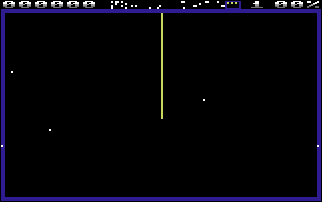
Zolyx

Zolyx: perfect movie fodder! Are you listening, Hollywood? I’ll write the screenplay for 50p and an extra-large bag of wine gums!

May 22, 2008. Read more in: Film, Gaming, News, Opinions, Retro gaming

Comments Off on Pac-Man: the movie

When friends reunited elsewhere

Or: When a business’s driver awakes after being asleep at the wheel

It must be pretty harsh when you find out that you’re totally irrelevant, not least when this is down to being superseded by something about a billion times better. I guess that’s how it feels to be Friends Reunited, who last night sent me some exciting news—their words, not mine.

Now, spam usually puts me in a bad mood, so “this news had better be truly exciting,” I thought. Otherwise, I’d have to say something sarcastic about it on my blog, obviously. So, what was this news, which was, as you’ll recall, exciting? It was this: Friends Reunited is now free (and, apparently, “much more sociable”, although I don’t recall the organisation being particularly aloof before).

Now, if I were a big ol’ dumb-head, I’d be thinking that Friends Reunited was being wonderful, and enabling people to get in touch for free, rekindling old friendships (and, presumably, reigniting old feuds). The thing is, I, like pretty much everyone else I know, abandoned Friends Reunited long ago, leaping over to Facebook, which just happens to have been free from the start and, wisely, has stayed that way.

It’s sad to see a supposedly older, wiser company in the field somehow miss the boat so spectacularly, and Friends Reunited’s latest attempt to not only stop the ship from sinking, but also prevent it from bursting into flames on the way down, smacks of desperation. It’s like when Netscape finally twigged about two years too late that, in the face of massive competition from Internet Explorer, it might be a good idea to stop charging for Navigator, what with a superior and free equivalent being available.

Still, it’s good to see that the money made during Friends Reunited’s time as a paid-for site hasn’t gone to waste. The new Friends Reunited tour is narrated by Martin Clunes. This alone should, clearly, be enough to make the entire world ditch Facebook immediately.

Facebook: less hateful once you’ve blocked all the applications.

May 9, 2008. Read more in: News, Opinions, Technology

Comments Off on When friends reunited elsewhere

« older postsnewer posts »