The mothballing of traditional media—when digital strikes

A couple of days ago, Josh Marshall’s article about his Kindle on Talking Points Memo got me thinking. He relates how on experiencing the device, he surprisingly got sucked into using it, which was subsequently followed by a dark epiphany:

“In our living room we have two big inset shelves where I keep all the books I feel like I need or want ready at hand. And last night, sitting in front of them, I had this dark epiphany. How much longer are these things going to be around? Not my books, though maybe them too. But just books. Physical, paper books. The few hundred or so I was looking at suddenly seemed like they were taking up an awful lot of space, like the whole business could dealt with a lot more cleanly and efficiently, if at some moral loss.”

This is the kind of statement I’d have scoffed at a few years ago, but we do seem to be rampaging ever onwards into a digital-only future regarding media. Newspapers are struggling, being replaced by online equivalents. The CD is clearly on its last legs, about to be obliterated by digital formats for all but those in the niche space. And although video has resisted this transition, things are on the move, and it’s clear that a combination of bandwidth and storage issues is the only thing holding this particular shift back.

And so, wither books? Almost certainly, and largely for convenience. As living spaces get smaller and the amount of crap we own grows, space is at a premium. Although I’m a staunch buyer of CDs, I almost never play them, instead ripping them to a Mac and playing the music back via iPods and amps. I keep threatening to put our CDs in the loft, but at that point, why bother even buying new CDs in the first place? (And, yes, I’m fully aware that online music purchases are generally in compressed format, but for the most part the formats are now in a decent enough quality that I can’t tell the difference, and most music is mixed so poorly and compressed so heavily that it makes no odds anyway.)

The danger, of course, is in terms of longevity. In moving from physical product to digital-only, we’re in danger of creating very temporary history. Already, people are finding that digitally printed photos often fade frighteningly quickly, massively at odds with faded but still perfectly visible black and white photos from the early portion of the last century. And digital file formats rapidly change and evolve. JPEG and MP3 may be dominant today, but what about in ten years? What about in 100? Are we rapidly moving towards a time where everything we create will be potentially lost within a few generations, all in the name of convenience?

March 31, 2009. Read more in: Opinions, Technology

2 Comments

Bring Down IE6 – dot com

Sometimes the best things in life start with a little mischief. That’s definitely the case with Bring Down IE6, a .net magazine microsite that I designed (using artwork from the wonderful people at ilovedust) and that launched on March 12.

Dan Oliver, the editor, was the culprit who lit the fuse. Knocking ideas around with me for features, he wondered if there was mileage in an article on the “growing trend to f—— IE”, meaning IE6, which even Facebook now hates. Being a web designer and also happening to know a lot of people who waste many hours dealing with IE6, I had a sneaking suspicion that, yes, this might just appeal to the mag’s readers.

The feature was duly commissioned, and I got to work, interviewing the likes of Jeff Zeldman and Bruce Lawson. I wrote the article, submitted it, and that was that. And then the mag hit the newsstands. Unusually, the article ended up online at the same time, rather than being delayed a few months, and there was one major addition: a badge.

Someone at .net had started a rallying cry, asking readers to download the ‘Bring Down IE6’ logo and link to the feature. But it didn’t seem loud enough. A spark went off in my head, and the microsite idea was born. It was then designed, built in suitably standards-compliant fashion, and IE6 was ignored bar an ‘upgrade’ notice that IE<7 users see. The finished site now sits at www.bringdownie6.com. Time will tell if it proves a success, but I’ve already seen the badge creeping out there and being attached to various designers’ blogs, which is heartening.

And despite the provocative and somewhat humorous tone of the site itself, the aim is deadly serious. It really is time for web designers to unite and finally get IE6 dealt with in some way. We need to move on, and together we will win.

Bring Down IE6

Bring down IE6! All we need now is cheerleaders.

March 12, 2009. Read more in: .net, Design, Magazines, News, Technology, Web design

Comments Off on Bring Down IE6 – dot com

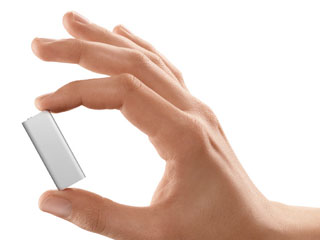
New iPod shuffle absurdly small

I remember buying one of the original iPod shuffles, thinking it might come in handy for walking about with, rather than ‘risking’ my expensive chunky iPod photo. In the end, the iPod photo sat unloved in a drawer (and, eventually, got wired into my amp), while the shuffle laughed heartily on its victory.

Far from being bothered by the perceived restrictions of the device (no screen, basic controls), I loved the shuffle’s durability, and due to an OCD-like iTunes set-up where everything’s rated, I could fill the tiny iPod with tracks of a certain length and quality, and then set off to town knowing that I had a selection of what I considered great music with me.

When the new shuffle came out—the one that’s a tiny clip—I bought one of those, too. The old shuffle was relegated somewhat (although it’s still dug out for long flights), because the new one’s sheer tininess made it a real winner. Again, no screen, but the competition’s tiny displays didn’t seduce me in the slightest.

Today, Apple went a stage further, with the latest version of the shuffle, and, yeah, there’s going to be a third one rattling around this house soon enough.

Amazingly, the device is even smaller that its predecessor, tinier than a door key. Because of this, the controls have shifted to the headphones (the one negative, since this means you’re stuffed if they break or you want to use non-Apple headphones), and VoiceOver has made its debut, making the lack of screen a non-issue. Now, the iPod shuffle, apparently conversant in 14 languages, can tell you what you’re listening to, and which playlist you’re playing.

Again, this highlights Apple’s desire to innovate, rather than just looking at the competition and doing something similar. It also shows that giving people what they want rather than what they think they want can pay dividends, in terms of features and industrial design. Most importantly, though, it appears that without Steve Jobs at the helm, things can continue, what with unknown devices still being in the pipeline. Take note, idiot reporters.

iPod shuffle

The only problem with the new shuffle was that it had to be kept at arm’s length, due to smelling of poo.

March 11, 2009. Read more in: Apple, News, Opinions, Technology

1 Comment

Gordon Brown wants eBay-style public services feedback system

Having been using the internet for more than a decade, I can’t think of two more broken ratings systems than those used by eBay and Amazon.

eBay’s appears largely based around screwing the other party over. To make things ‘better’, eBay recently removed the ability for sellers to leave feedback. This resulted in buyers realising they could ‘blackmail’ sellers with strong feedback scores, threatening to leave ‘negatives’ unless partial refunds were given.

Amazon’s system is just as bad, but in a very different way. Since the site enables people who’ve not bought an item to leave feedback, the reviews are largely rendered pointless. A stinking stream of “I’ve not bought this, but…” dribbles around the edge of every page, made all the more putrid when the reviewed item isn’t even available for another six months.

With these things in mind, it should come as no surprise that Gordon Brown’s Labour, bastions of IT idiocy, are now suggesting services like GPs and police should be rated in a similar way (source BBC News). The article notes that Brown said it was wrong that consumer websites such as Amazon and eBay had “higher standards of transparency” than those for public services.

Excuse me, but isn’t this the dumbest idea possible in this area? Sure, get official bodies to figure out if services are up to scratch, and run independent inquiries when things go very wrong. But the last thing we need for councils, the police and childcade is a bunch of one-star reviews by crazy people, annoyed that a service they’ve never used doesn’t do something it’s not supposed to do.

Interesting, though, that Brown notes how the government has been “too slow to make use of the enormous democratising power of information,” and yet ignores true democracy by avoiding giving the people referendums on things that actually matter. (Iraq, anyone?)

He also rattles on about ushering in “a new world of accountability in which parents, patients and local communities shape the services they receive, ensuring all our public services respond not simply to the hand of government, but to the voice of local people.” Note, though, that Brown avoids placing the government and himself in this arena.

March 10, 2009. Read more in: News, Opinions, Technology

1 Comment

Apple calls time on non-customer App Store reviews

According to MacRumors, Apple has removed non-customer reviews from the App Store. When the store first arrived, anyone could review any application, which, far from being a democratising process, merely resulted in idiots ‘reviewing’ applications they’d not downloaded. For example, ProRemote, a remote for people in busy recording studios, got slammed for costing £60+, via a number of quintessential “I haven’t used this app, but…” reviews.

Although removing these braindead comments doesn’t make App Store reviews perfect (every time an app’s price drops, users who bought at a more expensive price flock to the App Store to deploy one-star reviews of doom, and many other ‘reviewers’ don’t seem to understand how a five-star rating system works, offering surreal glowing one-star reviews), it does make it less broken. I’m sure Apple will get slammed by some, arguing the new system is more of a ‘closed garden’ but, frankly, every online reviews system should be like this.

As someone who reviews items professionally, I often find consumer reviews troublesome, since few people have the experience to make worthwhile comparisons. With a DVD, videogame or CD, that’s perhaps not the case, but few people will have used enough monitors, web-design apps, washing machines, TVs or ovens to have a truly informed opinion about where their shiny new purchase fits in the scheme of things. But when you allow non-customers to review anything, the result is always a car crash. Amazon is the most obvious example, with reviews appearing long before items become available (those for upcoming consoles are particularly absurd—a flurry of five-star reviews from the ‘pro’ camp and one-star opinions from the ‘anti’).

So, Apple is to be applauded for its decision. And if the company can deal with keyword-spamming and its underperforming store search over the coming months, the App Store will finally ensure users and developers do a happy dance, rather than grudgingly trudging through the mire for hours, in search of gems.

February 27, 2009. Read more in: Apple, News, Opinions, Technology

1 Comment

« older postsnewer posts »