Two articles from me on the fragrant TechRadar website, detailing the very best games (according to me, at least) for the iPhone and iPod touch:
The paid-games piece was particularly interesting to write, given that I had a shortlist of over 60 games that I had to brutally and mercilessly hack down. Needless to say that some of those games will make ‘the list’ when these articles are expanded over the coming months.
October 7, 2010. Read more in: Gaming, Opinions, Stuff by me
Last week, I bitched about iOS games, notably the general poor quality. Now I’m going to moan about websites. If you’ve created an app, I’ll visit your website in one of two capacities: as a consumer or as a journalist. Often, I’ll be a consumer and a journalist, just to confuse you.
As a consumer, here’s what I want to know:
- What does your product do? Describe it to me in under 50 words. Don’t say you can’t do that; and if you genuinely can’t write those words, hire a copywriter. They’ll likely bash out 50 words for a tin of beans. (And, yes, I know you want to say more than 50 words, but you can do that elsewhere. Think of your intro like a book jacket: publishers don’t print the entire story of a novel on the cover.)
- How much does your product cost? Don’t make me guess! Don’t make me launch iTunes. I hate iTunes. Just put a very obvious price sticker on the web page, even if it’s just in US dollars and you’re pretending the Euro and other currencies don’t exist.
- What does your app look like? Don’t compress your images to tiny thumbnails—it’s not 1995. If you’re not showing full-size iPhone grabs, you’re an idiot. iPad grabs should be at least half size. And don’t bung all kinds of junk over the grabs—ensure your app or game shines through, not your marketing drivel.
- Why do you hate me? This is specifically aimed at you if you’re using video instead of a screen grab. I don’t have time for that. I don’t have time for your dissolves and your ‘funny’ edits. Don’t fob me off with a video from YouTube that will take ages to load or boot an instance of Flash that will subsequently kick Safari in the nuts, or I will have to come round there and smack you.
- Where can I buy it? Provide a link to your App Store page, in case I want to buy your app. Don’t make me go to iTunes and type this in myself. I am lazy, and so is everyone else. Also, do you really want me to go to the App Store with the full intention of buying your product and then bump into NanoStudio or Dark Nebula 2 on the home page? That’s a battle you cannot win. Also, make your direct link big. Don’t hide it at the bottom of the page, in dark grey on a slightly darker grey background. You’re not a web-design agency from 1998.
- Where can I moan to you about your app? Yeah, you’re just a team of three and you don’t have time to deal with loads of email. Tough. If I’ve bought your product and it’s not working, I want to tell you. ‘Get Satisfaction’ does not count, because it doesn’t enable you to get satisfaction—you just get annoyed about the vague replies to a billion existing topics. A forum does not count, unless you are on there every day and answer every question (which you won’t), and, besides, I might not want to put my comment out there for everyone to see. So just put a form online or an email address—and when that message comes in, respond to it.
As a journalist, here’s what I want to know:
- All of the above six points. Seriously. If you don’t provide that information right from the start, the chances of me wanting to review your product drop by about eleven billion percent.
- Where can I download full-quality and full-size PNG images of your app that aren’t covered in garbage? I don’t care how you do this. A ZIP of PNG files is fine. 36 bonus points if you bundle them with a quick review guide. Just don’t make me beg. And if you’re a games dev, don’t tell me to take the grabs myself. For the record, I do try to do this for every review I write, but when you’re already using two thumbs to hurl your virtual car around a virtual corner at a virtual 100 miles per hour, it’s not exactly simple to also hit ‘home’ plus ‘lock’.
- How do I get in touch with you? No, ‘Get Sodding Satisfaction’ still doesn’t count. Give me an email address, such as press@coolandfunkyiosstuff.com. Or give me a contact form—I don’t care. But here’s the thing: answer my email. Really. By not answering emails from frazzled, stressed-out journos, you’re reducing your chances of coverage by so many percent that a number doesn’t even exist to say how big the reduction actually is. It’s that big.
Usefully, if you’re not an iOS developer, these rules all still apply, so don’t think you’re off the hook, Mac- or Windows-dev person.
Next in this stunning series: helpful hints about why your iTunes App Store page sucks, and what you can do about it.
October 5, 2010. Read more in: Gaming, Opinions
After a longer gestation than that of a blue whale, Podgamer finally emerged blinking into the daylight today.
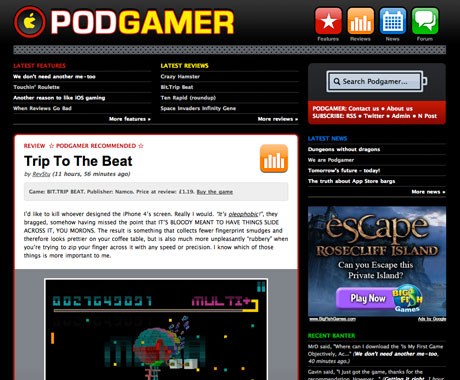
It’s a co-production between yours truly, Stu Campbell and J Nash. The content: game reviews and features for iPhone, iPod touch and iPad, except not rubbish. The idea: a fun, irreverent games mag (like the old days, when Amiga Power, Crash and Your Sinclair reigned supreme) that helps you find games that aren’t rubbish on the App Store. Or helps you find rubbish stuff, so you can point and laugh at it. Anyway, podgamer.com—bookmark it.
UPDATE: And, in case anyone pops across this article and wonders what’s going on, Stuart Campbell ragequit Podgamer and has now disabled (possibly deleted) the entire site without warning and locked Nash and myself out of the FTP, despite stating via email on April 7:
I’ve temporarily disabled PG until the proper morning
Maybe ‘the proper morning’ meant the dawn of 2051 or something.
October 1, 2010. Read more in: Gaming
Jason Fried at 37signals asks “What happens when it’s all glass?”, worrying about whether Apple will lose its edge with the way industrial design is moving:
I wonder if Apple will soon lose their perceived industrial design edge. It’s not that they aren’t incredibly good at it—they are the best in the business—it’s that industrial design is trending towards transparency. It’s all going glass. Everything is turning into a screen, from edge to edge. Once it’s all about glass, it’s all about software.
Luckily for Apple their software is outstanding. But, I think over time great software is less of a competitive advantage than killer hardware only because software, across the board, is getting better quickly.
The key here is perception. Apple must be careful to not get drowned out by a crowd of me-too imitators. Technology news pages are full of Android tablets that are supposed iPad killers, but all I see for the most part is a gang of iPad rip-offs. Advocates argue that Apple’s design decisions were ‘obvious’, hence everyone’s interfaces being so similar to iOS. If that’s the case, why did no-one release something like iOS before Apple? Why did it take the iPhone and iPad to push the industry forwards?
That’s why this time round things will be different. Apple’s share will of course dwindle (although its profits won’t), but not to the level seen on the desktop (where, remember, Apple is still profitable, despite commanding only a tiny market-share). And Apple will always excite the industry and consumers, because it dares to innovate. Android may have the lead in a few areas (such as notifications), but iOS forges ahead almost everywhere else, especially in places where it really matters, such as usability, robustness and elegance.
Differentiation is going to be the key in mobile and touch. Apple has the best industrial design, the best product integration, the best vision and the best selection of mobile apps. These things didn’t happen by accident and they didn’t happen by copying someone else. So what will happen when it’s all glass? Apple will still be out in front.
September 30, 2010. Read more in: Apple, Opinions, Technology
Due to reviewing a lot of iOS games of late, I now have an RSS feed that spits an overview of every new iOS game into Google Reader. And, my word, there’s an awful lot of utter crap out there. While I remain of the opinion that iOS is the greatest gaming system to date, it probably also has the worst ratio of good to bad games.
Ironically, much of the problem stems from Apple’s openness. Yes, you read that right. People bitch about the App Store approvals process, but it’s a hell of a lot easier to get a game on to the App Store than, say, make it for the Nintendo DS and get it on to store shelves. Apple recently in its review guidelines made a plea for quality, saying professional developers didn’t want their apps surrounded by ‘amateur hour’; from what I can tell, they already are.
So, if you’re planning on releasing an iOS game, I’ve provided some helpful tips below; and if you’re an app dev, now chuckling to yourself, switch ‘game’ for ‘app’ and see if you’re still laughing.
- Are you planning on releasing ‘My First Game’, just because you can? If so, don’t bother, unless it’s actually ‘My First Game, Which, Objectively, Is Actually Pretty Damn Good’.
- Are there already dozens of similar games on the App Store? If so, don’t bother, unless your title makes substantial improvements and changes to the genre. We don’t need yet another sodding Solitaire game, for example, or another 99-cent Reversi. Just stop it already.
- Can you think of at least a few dozen people who would buy your game? If there’s no market for it, don’t bother trying to sell it—just send ad-hoc builds to your friends.
- Does your game look and sound like utter crap? If so, consider getting an artist or musician on board. “I’m not very good at art and music” is not an excuse when there are loads of people out there who’d love the chance to collaborate with you on a project.
- Have you found a game on another platform and just ported it right across, without any consideration for the unique aspects of iOS interfaces? You’re not Sega, you know. (And if you are Sega, just set fire to your Mega Drive/Genesis emulator already.) The best games on iOS are the ones that take advantage of its specific features, not the ones that try to fight the system (man).
In my next post on this subject, I’ll return to a subject that fills me with an equal amount of HULK SMASH: app and game websites, which developers are still screwing up with alarming regularity.
September 29, 2010. Read more in: Apple, Gaming, Opinions