The Apple tax and the Mac v. PC argument (again)

Microsoft’s latest advertising campaign is a slightly odd one in many ways—it thrusts dollars into the hands of normal people (well, actors acting out the role of normal people) and gets them to buy a new computer. Obviously, they look at Macs, spit on them and grab a PC. At the same time, Microsoft continues to crow about the so-called ‘Apple Tax’.

Aside from the obvious danger in an advertising campaign that puts forward the argument that the only benefit your product has is price, the Apple Tax argument is one that holds little water when explored fully. Unfortunately, it’s often hard to put into words a succinct argument why the Mac side is typically better, and therefore why someone can justify spending more on what many people initially see as the same thing—‘just a computer’. Phrases like “it’s just better” and “you won’t get it until you try it” only work when someone has tried it and then tries to convince someone else to ‘cross over’ at a later date.

One of the better attempts of recent times arrived yesterday, courtesy of Harry McCracken in his article Eight Reasons Your Next Computer Should Be a Mac. He says: “Next time I encounter a Microsoft executive tsk-tsking about the onerous ‘Apple Tax’ imposed by a Mac’s needless glitz, I’m tempted to ask him what car he drives—and whether he chose the model with the cloth seats and hand-cranked windows, or one with a few creature comforts.”

The thing is, even this argument often falls on deaf ears, which makes me ask the following question: why are computers still considered dreary, strictly functional devices to so many people? When consumers have the money, they want a flash car with nice stuff, a decent mobile phone with bells and whistles, a good-looking television, and a sparkly watch. They don’t want the near-junked car with manual windows, the mobile phone that barely manages to make text messages, a TV from the dark ages, and a 1980s Casio digital watch.

With computers and the internet becoming near ubiquitous in so many people’s lives, it’s strange that so many people, as Stephen Fry put it when I interviewed him, “spend their lives in front of a screen […] in a Windows environment, the equivalent of a ‘sick building syndrome’ office, with strip lighting, ugly furniture and no freshness, sexiness or imagination in design. People are dragging out their lives in the computer equivalent of a sink estate and no-one questions it.”

I regularly question it, but I still haven’t found any answers.

April 27, 2009. Read more in: Apple, Opinions, Technology

6 Comments

When will the App Store learn to count?

Given how much care Apple usually puts into its products, and especially into the small details, it’s amazing that the App Store’s ability to count is worse than Sesame Street’s resident vampire after a full-frontal lobotomy.

The iPhone’s App Store app is terrible at doing this, regularly flagging a certain number of updates and getting the total wrong. But iTunes is even worse. The Applications sidebar item will cheerily tell you about new app updates, you’ll click it, and you’ll then be told no updates are available. Cleverly, the Applications icon won’t then update, sticking to its guns that there are updates to be had, despite the fact there clearly aren’t.

This morning, the farce was in full swing. “One app update,” exclaimed the Applications item. I click it. There are six items ready for download. Duly downloaded, the App Store happily tells me there are no more updates. Inexplicably, the Applications item now claims there are two apps ready for download.

This probably sounds needlessly picky (and, to some extent, it is), given that no other company has come close to emulating the App Store (and, frankly, I think few will, even in the long term). But it’s hard to always sing the App Store’s praises when the damn thing can’t even count.

UPDATE: Purely by chance, I today discovered that this ‘quirk’ is down to there being multiple accounts on my Mac. Although one account was up to date, another had apps ready for download. Of course, iTunes doesn’t actually bother telling you this might be the case, and so it’s still a black mark for Apple, for an unusually unintuitive UI decision.

iTunes counting

So, do I have two downloads ready or none at all, App Store? TELL ME!

April 10, 2009. Read more in: Apple, Opinions, Technology

Comments Off on When will the App Store learn to count?

How to update your online store, the Apple way

Apple hype

The standard online retailer guide to updating an online store:

  1. Upload products quietly, in the background, without fuss. Maybe if the product is particularly exciting, add it to the front page.

The Apple method of updating its online store:

  1. Accidentally leak a minor product shot by accidentally uploading it a few weeks before release. Accidentally. Really.
  2. Wait for hundreds of Apple rumour websites to get terribly excited about a tiny incremental update to a nothing product.
  3. Watch as frenzied Apple fans argue about what other updates are on the way, such as a $5 solar-powered iPhone that also makes perfect toast and tea via WiFi.
  4. Abruptly take down your entire international online store, making it impossible for anyone to buy anything. Add an obnoxious post-it note for good measure.
  5. Wait as Apple fans drive themselves into an apoplectic frenzy, trying to figure out what exciting new things are going to be added imminently.
  6. Watch as Apple news sites report that you took your store down, which means exciting things.
  7. Sit back and laugh heartily, safe in the knowledge that even though the updates are tiny, you’ve just got more marketing than most companies get for a new product launch.
  8. Put the site back online, with as many ‘new’ badges as possible.
  9. Wait for the internet to recover from millions of Apple users refreshing the Apple store fifteen times per second.
  10. Wait for orders to flood in from Apple users starved of the store for a full 90 minutes.
  11. Lather, rinse, repeat.

April 7, 2009. Read more in: Apple, Humour, Technology

3 Comments

New iPod shuffle absurdly small

I remember buying one of the original iPod shuffles, thinking it might come in handy for walking about with, rather than ‘risking’ my expensive chunky iPod photo. In the end, the iPod photo sat unloved in a drawer (and, eventually, got wired into my amp), while the shuffle laughed heartily on its victory.

Far from being bothered by the perceived restrictions of the device (no screen, basic controls), I loved the shuffle’s durability, and due to an OCD-like iTunes set-up where everything’s rated, I could fill the tiny iPod with tracks of a certain length and quality, and then set off to town knowing that I had a selection of what I considered great music with me.

When the new shuffle came out—the one that’s a tiny clip—I bought one of those, too. The old shuffle was relegated somewhat (although it’s still dug out for long flights), because the new one’s sheer tininess made it a real winner. Again, no screen, but the competition’s tiny displays didn’t seduce me in the slightest.

Today, Apple went a stage further, with the latest version of the shuffle, and, yeah, there’s going to be a third one rattling around this house soon enough.

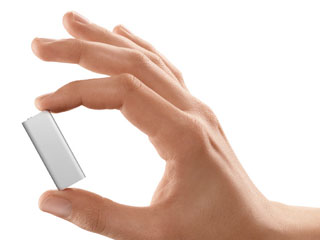
Amazingly, the device is even smaller that its predecessor, tinier than a door key. Because of this, the controls have shifted to the headphones (the one negative, since this means you’re stuffed if they break or you want to use non-Apple headphones), and VoiceOver has made its debut, making the lack of screen a non-issue. Now, the iPod shuffle, apparently conversant in 14 languages, can tell you what you’re listening to, and which playlist you’re playing.

Again, this highlights Apple’s desire to innovate, rather than just looking at the competition and doing something similar. It also shows that giving people what they want rather than what they think they want can pay dividends, in terms of features and industrial design. Most importantly, though, it appears that without Steve Jobs at the helm, things can continue, what with unknown devices still being in the pipeline. Take note, idiot reporters.

iPod shuffle

The only problem with the new shuffle was that it had to be kept at arm’s length, due to smelling of poo.

March 11, 2009. Read more in: Apple, News, Opinions, Technology

1 Comment

Apple calls time on non-customer App Store reviews

According to MacRumors, Apple has removed non-customer reviews from the App Store. When the store first arrived, anyone could review any application, which, far from being a democratising process, merely resulted in idiots ‘reviewing’ applications they’d not downloaded. For example, ProRemote, a remote for people in busy recording studios, got slammed for costing £60+, via a number of quintessential “I haven’t used this app, but…” reviews.

Although removing these braindead comments doesn’t make App Store reviews perfect (every time an app’s price drops, users who bought at a more expensive price flock to the App Store to deploy one-star reviews of doom, and many other ‘reviewers’ don’t seem to understand how a five-star rating system works, offering surreal glowing one-star reviews), it does make it less broken. I’m sure Apple will get slammed by some, arguing the new system is more of a ‘closed garden’ but, frankly, every online reviews system should be like this.

As someone who reviews items professionally, I often find consumer reviews troublesome, since few people have the experience to make worthwhile comparisons. With a DVD, videogame or CD, that’s perhaps not the case, but few people will have used enough monitors, web-design apps, washing machines, TVs or ovens to have a truly informed opinion about where their shiny new purchase fits in the scheme of things. But when you allow non-customers to review anything, the result is always a car crash. Amazon is the most obvious example, with reviews appearing long before items become available (those for upcoming consoles are particularly absurd—a flurry of five-star reviews from the ‘pro’ camp and one-star opinions from the ‘anti’).

So, Apple is to be applauded for its decision. And if the company can deal with keyword-spamming and its underperforming store search over the coming months, the App Store will finally ensure users and developers do a happy dance, rather than grudgingly trudging through the mire for hours, in search of gems.

February 27, 2009. Read more in: Apple, News, Opinions, Technology

1 Comment

« older postsnewer posts »