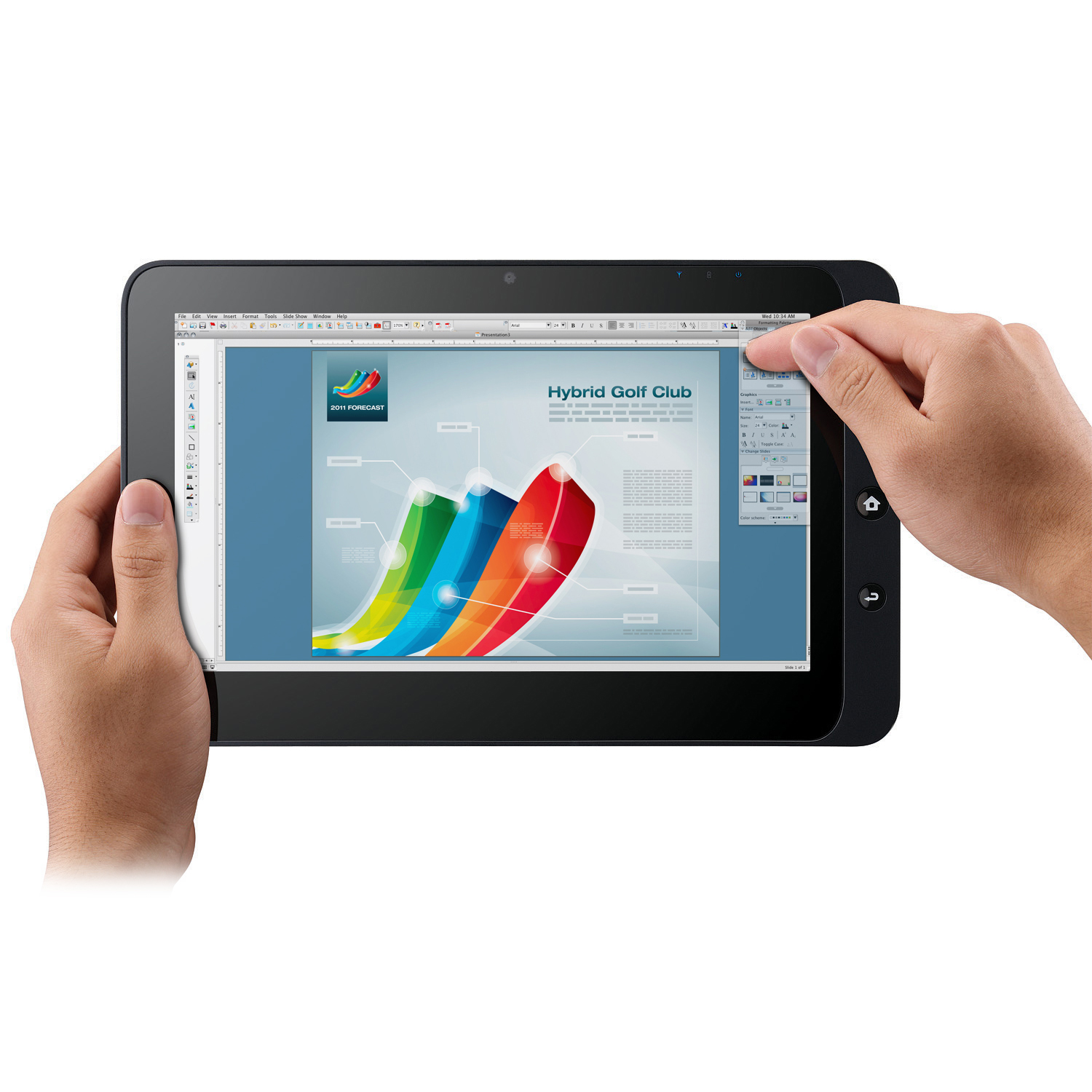
So you’ve got new iPad killer coming out, and it, for reasons known only to slightly crazy people, dual-boots into Windows 7 and Android 1.6 (two operating systems clearly leagues ahead of iOS when it comes to optimal tablet experiences—again, if you’re stark staring mad). What better way to advertise it than using a badly cropped grab of a Microsoft Office app running in Mac OS X?
In case of deletion, here’s a bit of it:

Nice. The close-up of exciting touch-based workflow in action is also, I’m sure you’ll agree, brilliant and doesn’t look at all like it was faked by a bored unpaid intern:

Hat tip: Daring Fireball.
March 8, 2011. Read more in: News, Opinions, Technology
Gary Marshall on the iPad 2:
What Apple gets—and what I think a lot of firms don’t—is that most people, the kind of people who are currently buying iOS devices and apps in extraordinary quantities, don’t care about specifications any more than they want to think about how their lunchtime sausages are made.
Geeks forget this. Many in the tech press also forget this. People care about the experience, not the innards of a device.
I wrote along similar lines on TechRadar:
For example, instead of boasting about the cameras in the iPad 2, Apple concentrated on demoing FaceTime and Photo Booth. The company then showcased practical applications of footage taken by the new rear camera by revealing the revised iMovie – an update to the $4.99/£2.99 app.
iMovie is now universal and on the iPad has an interface resembling the desktop release. And as if to drive the point home regarding what Apple really cares about (clue: it’s not gigahertz and gigabytes – it’s enabling creativity), GarageBand for iPad was unleashed, boasting an interface in many ways superior to that of the Mac version.
The point is that technology and specs are all fine, but they only really mean something if you can employ them. It’s no good having a quad-core tablet with 8GB of RAM if the only software available is a slightly knackered version of Solitaire.
This is what every other company in the tech space needs to understand. The killer feature of the iPad 2 launch wasn’t its RAM or its chip-speed; it wasn’t the megapixels in the camera sensor, nor even the tablet’s form; the killer feature of the iPad 2 is that you can do a ton of fun stuff with it.
March 7, 2011. Read more in: Apple, News, Opinions, Technology
A while back, Samsung VP Lee Young-hee was reportedly misquoted when talking about the sales of its wee iPad wannabe, the 7-inch Galaxy Tab. He was stated to have said:
As you heard, our sell-in [for the Galaxy Tab] was quite aggressive… around two million. In terms of sell-out, we believe it was quite small.
Samsung then argued that ‘quite small’ was in fact ‘quite smooth’, which sort of makes sense if you get a bit drunk. On March 4, Yonhap News quoted Lee Don-joo, executive vice president of Samsung’s mobile division, talking about the soon-to-be-unveiled Galaxy Tab 10.1:
We will have to improve the parts that are inadequate. Apple made [the iPad 2] very thin.
Again, Samsung has presumably been misquoted. Clearly, he meant to say ‘inedible’, because Samsung’s going to go one better than Apple in making its tablet totally safe should your child get really frustrated with Angry Birds and take a chunk out of the device with its teeth.
And on the Galaxy Tab being close to $900, compared to the iPad 2’s $499–$829 range:
The 10-inch (tablet) was to be priced higher than the 7-inch (tablet) but we will have to think that over.
By ‘higher’, Samsung presumably meant ‘lower’. After all, there’s no way an iPad competitor would today launch its product at a higher price-point than Apple’s latest device, because that would just be stupid.
March 7, 2011. Read more in: Apple, News, Opinions, Technology
Awww. “Compare your baskets.. find love,” says Asda Dating. (Never mind the attempt at The Lady And The Tramp spaghetti cuteness in the site’s photo—the woman looks like a bit too intent, but it’s OK, because her bloke can defend himself with the power of a fork.)
But will Asda also offer its price promise? “If your date isn’t 10% cheaper than our rivals, we’ll give you back the difference.”
Hat tip: Nigel Whitfield. Amusing follow-up from @MayorWatch: “Presumably this is [where] that Asda bum-slapping thing really comes into its own?”
March 7, 2011. Read more in: News, Technology
I’m Contributing Editor to Tap! magazine, Future Publishing’s spiffy and chunky iOS magazine. I look after the games section, and I therefore get quite regular emails from developers and PRs, asking how they can get games reviewed in the mag.
Ultimately, there’s no way to guarantee a slot in Tap!, bar releasing a totally amazing game (i.e. along similar quality lines as World of Goo HD and Strategery), but there are a number of ways you can at least boost your chances. None of these things are rocket surgery, but it’s amazing how many devs utterly ignore them.
- Let me know about your game. Email me or get in touch on Twitter. If I know about your game, there’s obviously more chance of it getting coverage.
- Send me a promo code. Bizarrely, this surprises many devs, but, yes, send me a promo code and your game is more likely to make the cut, simply because something that’s good and had a quick test beats something that might be good but that I’ve not tried.
- Be responsive. If I email you and ask something, get back to me in good time. I’m not suggesting you need to be at my beck and call, but when I’ve a question about some stupid bug or issue, it’s in your interest to say “actually, we’re releasing an update tomorrow that fixes things” (whereupon I’ll rereview the product) than nothing.
Devs also do themselves a massive disservice in general regarding their App Store pages, wrecking discoverability. I have an RSS feed that pipes in every new iOS game release and I check every entry, to make a shortlist for Tap! Some games are overlooked or discarded because they don’t immediately make it clear what the game’s about. So, some handy tips:
- Your first App Store grab should show gameplay. It should be an in-game shot that shows your game at its best. If you’re showing a title screen, or, God forbid, some kind of options screen or social-networking bollocks, you just scuppered your chances of coverage by at least 50 per cent. (And if you’re dumb enough to not include any gameplay shots at all, I don’t even want to look at you.)
- Your description should start off with an extremely succinct overview of what your game’s about. Don’t get clever and don’t start by boasting how Game Blog No-one’s Ever Heard Of (dot com) gave you 4/5 and thought your game was “the dog’s doo-dahs”. Practically every game gets a good review from somewhere, but I don’t care about that—I want to know what your game’s about. (By all means include snippets of reviews, by the way—just don’t lead with them.) Note that this and the previous tip will also benefit you regarding snaring customers—make them excited right away, and don’t make them scroll.
- You should make it amazingly obvious how to get in touch. You have company and support links on your App Store page, so bloody well use them. And don’t link them to nothing. If I’m reviewing 30 games for a single issue of Tap!, I’m not going to waste an hour tracking down each developer. Link to your Twitter or an email address, or if you link to your website, make damn sure there’s a very obvious means of getting in touch with you. Also, ensure you check your incoming pr@ (or whatever) address more than once in a blue moon.
All these tips may seem obvious, but when I constantly hear how developers are pissed off at a lack of mainstream coverage of their games (or how unfair the App Store is, because big companies get more coverage), it’s amazing how many make almost no effort to fix things in their favour. The second set of above tips would maybe take you a half-hour to implement, but they could be the difference between your game being ignored entirely and it getting a two-page spread in a magazine.
March 7, 2011. Read more in: Gaming, Helpful hints, iOS gaming, Technology